
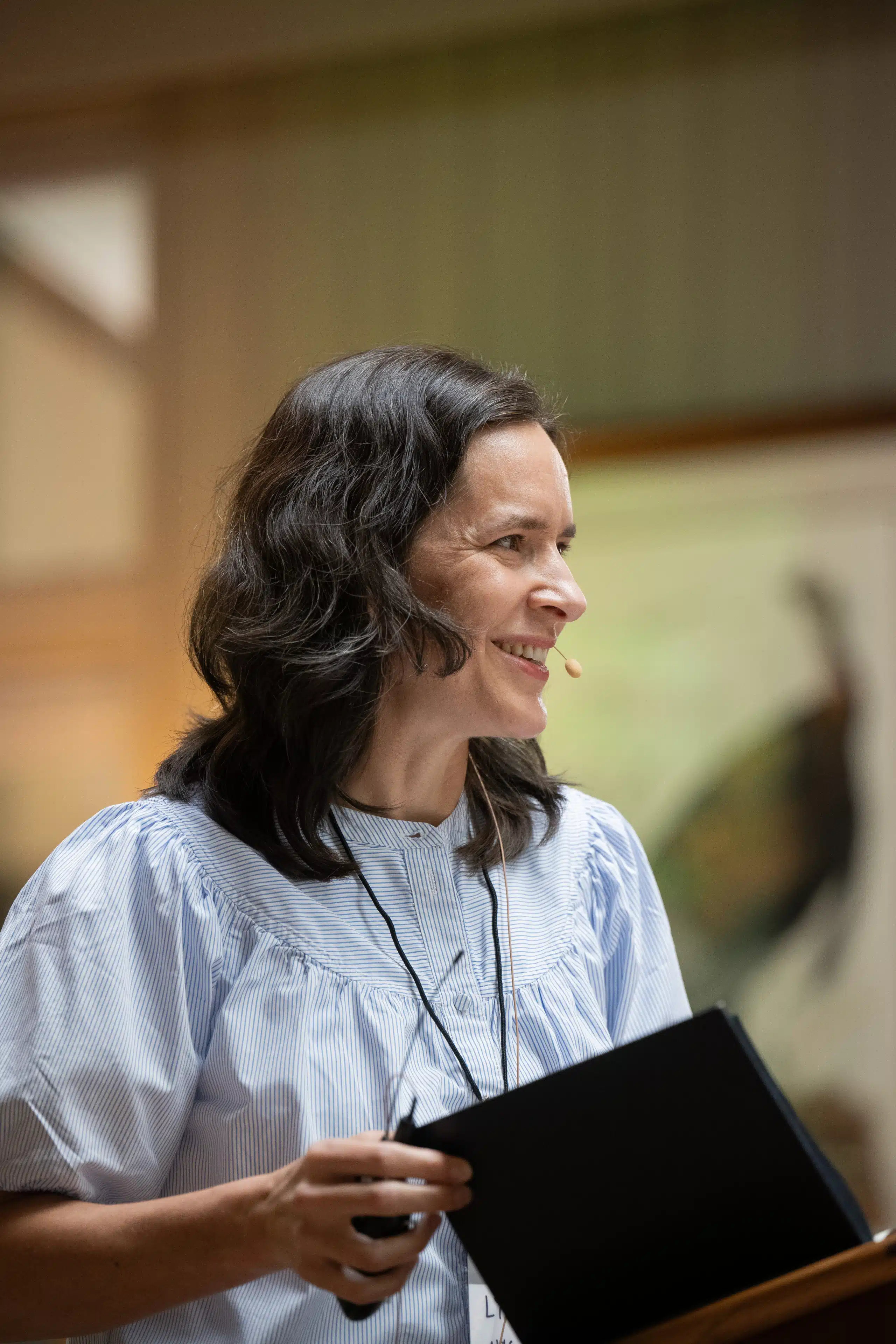


Five-time Emmy award-winning journalist Rome Hartman talks with Marcus Goodyear and Camille Hall-Ortega to reflect on faith, leadership, and patriotism. They discuss three presidents—Jimmy Carter, Ronald Reagan, and Gerald Ford—each of whom spoke at H. E. Butt Foundation events in the past. It’s a conversation about humility, power, public service, and the enduring challenge of loving a country honestly—celebrating its gifts while remaining willing to examine its shortcomings.
00:00:00:01 – 00:00:29:13
Rome Hartman
This is not a perfect union. It’s so far from a perfect union and calling it out as you see it and being willing to listen to others call it out as they see it. That is a really important part of of what makes this country special. And anything that demonizes debate, I think, is the wrong thing.
00:00:29:15 – 00:00:54:15
Marcus Goodyear
Today we are wishing a very happy birthday to the United States of America. 250 years after the Declaration of Independence, we still hold these truths to be self-evident, that all men are created equal, that they are endowed by their creator with certain unalienable rights. Life, Liberty and the pursuit of happiness. What better way to celebrate than to look back at some of the great leaders of our country?
00:00:54:18 – 00:01:19:19
Marcus Goodyear
Three great leaders have addressed the Foundation audiences between 1974 and 1978. Two of them, Jimmy Carter and Ronald Reagan, would go on to become presidents of the United States, and a third, Gerald Ford, had already been president. They were speaking to similar audiences. Christian leaders concerned about the integration of faith and work from the H. E. Butt Foundation. I’m Marcus Goodyear, and this is The Echoes Podcast.
00:01:19:20 – 00:01:42:08
Marcus Goodyear
On today’s episode, we’re joined by Rome Hartman. He is a journalist with multiple Emmy Awards from his 23 years at 60 minutes, plus his time as a producer at NBC, BBC and CBS Evening News. He’s also moderated Laity Leadership Institutes for the Foundation around the country. Today, we’re celebrating our country with a conversation about faith, leadership and power.
00:01:42:09 – 00:01:45:14
Marcus Goodyear
I’m here with my co-host, Camille Hall-Ortega. Hi, Camille.
00:01:45:19 – 00:01:47:19
Camille Hall-Ortega
Hi, Marcus. Hi, Rome.
00:01:48:00 – 00:01:49:17
Rome Hartman
Hi, Rome.
00:01:49:17 – 00:01:51:15
Marcus Goodyear
Welcome. We’re so honored to talk with, you.
00:01:51:16 – 00:01:55:03
Rome Hartman
Know, I my honor, entirely. Thank you for the invitation.
00:01:55:04 – 00:02:21:05
Marcus Goodyear
Today we are celebrating America’s turning 250. And we’re going to listen to some recordings from our archives that take us back to America. 200 to the Bicentennial. That was 1976. And America had things like Schoolhouse Rock. There was a new Broadway musical called 1776. There was this real spirit of national celebration happening. And yet the country at that time was still reeling from Watergate.
00:02:21:06 – 00:02:34:21
Marcus Goodyear
Nixon had been impeached in July 1974. He had resigned in August. There was this tension between patriotism and disillusionment. I’d be curious if you just respond to that idea and that intro.
00:02:35:00 – 00:03:01:16
Rome Hartman
It’s interesting. 1976 I was in Washington, D.C. that summer for the bicentennial summer. I was a junior in college, and it was my first foot in the water of television journalism. I had an internship at the local CBS affiliate in Washington, D.C. it was really my first time in Washington and my first time to experience anything to do with journalism.
00:03:01:16 – 00:03:30:21
Rome Hartman
I remember it as being a summer of celebration because there were all sorts of events associated with the bicentennial. But as you said, Marcus, that was a time of considerable turmoil in the United States. And I was intensely engaged in the Watergate scandal. That may have been the thing that made me think about journalism in the first place, because at that point, the journalists were real heroes of Watergate, you know, Woodward and Bernstein.
00:03:30:21 – 00:03:59:00
Rome Hartman
If not for them, Nixon might have gotten away with it. Yeah. And so I remember thinking of them as heroic figures. Didn’t much have to do with the anniversary of America and in my mind at the time. But being in Washington in the wake of Watergate and in the wake of the turmoil of Nixon’s resignation and everything else, it was a curious mix of of feelings and emotions, for sure.
00:03:59:01 – 00:04:29:00
Camille Hall-Ortega
I’m wondering if you can sort of paint a picture where we can kind of compare and contrast that mood that you’re describing, this bicentennial celebration in this feeling of patriotism, post Watergate and then patriotism and the celebration of the upcoming 250th birthday. What do you think are some of the similarities and differences for mood and for how patriotism pans out?
00:04:29:01 – 00:05:03:05
Rome Hartman
Well, I guess I dare to hope that this 250th anniversary will be a moment of unity in a time of disunity. Maybe that deep breath is something that we all need to try to take. You know, this is a time of great division in our country, and the idea of patriotism is feels a little bit compromised in some ways.
00:05:03:07 – 00:05:46:04
Rome Hartman
I think people who perhaps oppose the, the, the current administration feel like they’ve been shut out of the ability to feel patriotic, that that patriotism has been made political and in some ways is disunity rather than unifying. And I know people, you know, across the political, political spectrum. And I think everybody across the spectrum feels the need to kind of reclaim patriotism as a unifier as opposed to a divider.
00:05:46:04 – 00:05:59:05
Marcus Goodyear
So you have worked for many news organizations over the years. You mentioned this already. Can you talk just a little bit about how a little bit more about how you understood your role in the media throughout the course of your career?
00:05:59:06 – 00:06:29:12
Rome Hartman
Well, I think back to that, that summer of, of 1976, I was not yet a journalist. I had an internship that allowed me to observe journalism and media for the first time, and I found it incredibly exciting. You know, I had no job except to get coffee and make copies on the assignment desk of a local television station, but I found the pace of it really appealing.
00:06:29:12 – 00:06:52:23
Rome Hartman
I found the deadlines really appealing, and the idea that we made something every single day. We made it a product every day, and then. And we made it as good as we could make it. By the time, you know, 6:00 rolled around, that was when the local news started at the time. And then the next day we came back and tried to make it another product and then do it a little better than the day before.
00:06:53:00 – 00:07:20:14
Rome Hartman
So I found the rhythm and the pace and the deadlines most appealing at the beginning. And then I worked in a bunch of different jobs, as you said, you know, three jobs in local television, was hired by CBS in 1983, came back to Washington in 1986, and that’s when I became the white House producer. So my role has been I’ve done a bunch of different jobs in a bunch of different places.
00:07:20:14 – 00:07:44:21
Rome Hartman
As you said, the larger role of the media lord over the course of my career. The only thing that has been constant is constant change. I cannot I mean, that’s true in every field, really, or every profession. I don’t think of journalism as a profession, by the way. I think of it as a craft, a trade.
00:07:44:22 – 00:07:45:13
Marcus Goodyear
Oh, interesting.
00:07:45:15 – 00:07:54:15
Rome Hartman
Yeah. And because, you know, nobody gets their doctorate and the people that do, it’s a waste of time. I mean, in journalism, I’m not.
00:07:54:15 – 00:07:57:03
Marcus Goodyear
So I was tracking.
00:07:57:04 – 00:07:59:21
Rome Hartman
There are many, many doctors that are hugely useful.
00:07:59:22 – 00:08:00:21
Marcus Goodyear
But yet.
00:08:01:00 – 00:08:06:08
Rome Hartman
In journalism it’s it’s more a system of apprenticeship as in a trade.
00:08:06:09 – 00:08:07:07
Marcus Goodyear
Yeah. Yeah.
00:08:07:08 – 00:08:20:20
Camille Hall-Ortega
I’m curious, you’re mentioning marveling at change in the media over the course of the years of your career and beyond. What’s maybe the most surprising change you’ve witnessed for media?
00:08:20:22 – 00:08:33:02
Rome Hartman
Yeah, surprising is is is the right word, I think, because I guess I’ve been surprised at the level of atomization.
00:08:33:04 – 00:08:56:18
Rome Hartman
Technologically. Of course. You know, when I started at CBS news, the barriers to entry to to be part of the national conversation or to cover stories was absolutely high. Wow. Only a few people could do it. You know, there were basically three networks plus PBS, and nobody else had a chance to do this. It was just too hard.
00:08:56:19 – 00:09:22:19
Rome Hartman
There were there were the channels of distribution were were very few and far between and quite tightly controlled by the people that wanted to hold it that way. Today, anybody with a laptop and a microphone can have a voice. Here we are. Right, right. Yeah, but you know what I mean. It’s the atomization in many ways is a wonderful thing.
00:09:22:20 – 00:09:37:12
Camille Hall-Ortega
Sure. Yeah, I think it probably goes without saying that there’s an endless list of pros and and also cons there that we’ve got folks with a seat at the table that may have never had a seat at the table. And we’ve got some voices that maybe are just noise.
00:09:37:14 – 00:09:38:19
Rome Hartman
Yeah, yeah.
00:09:38:22 – 00:10:03:23
Marcus Goodyear
And in some ways, I think of it as an age of new, new yellow journalism where people are kind of chasing the the angriest voices, the most interesting voices, whether there’s truth there or not. But in talking about all of this change, I think about the way the presidency has changed, or I think about our relationship to the presidency changing and the relationship between the presidency and the changes in technology.
00:10:03:23 – 00:10:11:02
Marcus Goodyear
And I wonder, how do you think about the president as a role in its relationship to all of these things?
00:10:11:03 – 00:10:14:11
Rome Hartman
Well, it depends on the president, I think.
00:10:14:13 – 00:10:17:00
Marcus Goodyear
Yeah. I mean, the.
00:10:17:01 – 00:10:54:12
Rome Hartman
Yeah, in some ways, the evolution of that office or the way that in which that office is used mirrors the, the changes in, in technology and in media quite well. I mean, you have to go back to Roosevelt to think of the first president who really took advantage of technology. You know, Roosevelt’s fireside chats were revolutionary and and in a way gave him the opportunity to speak directly to the public with no filter in between.
00:10:54:15 – 00:11:21:00
Rome Hartman
Now, presidents always had that power. But but he he figured out that radio could be a medium that allowed him to speak directly to the population. Every president since has done that to one degree or another. I remember Reagan. I think it was Reagan that started the weekly Saturday radio address, which harken back a little bit to to what Roosevelt had done.
00:11:21:01 – 00:11:52:00
Rome Hartman
I don’t think they do that anymore. And, and I’m not quite sure when it stopped. But those Saturday morning radio addresses, I don’t know if they were a little short things. They were like five minutes long. They were they were not much longer than Howard Butts bits on the radio, but I thought they were interesting. And Reagan’s in particular, you know, he paid attention to it and he and he cared about it, I think partly because he had, you know, he had worked on the radio at the very beginning of his career.
00:11:52:00 – 00:12:14:20
Rome Hartman
I have a story to tell about the one time that I was there when he was recording the radio address was probably too long for this. So you guys can cut it if you want, but the way it used to work is that the president that, you know, and Reagan was the president I was covering would would record or maybe it was broadcast live.
00:12:14:21 – 00:12:40:02
Rome Hartman
The the Saturday radio address on Saturday morning and a network from the pool, the pool of of the three networks at the time, we had to provide the radio technician and then an editorial body to go physically to where the president was going to, was going to give the radio address. That was the way it worked. That was the rules under which we all operated.
00:12:40:02 – 00:13:03:00
Rome Hartman
And so was CBS turn to do the Saturday radio address. And the radio technician was a guy named John Daly, and I was the editorial body. I had no real role except to stand there. We took this very perilous drive up to Rancho del Cielo, which was Reagan’s ranch, up in the in the Simi Valley in California, very remote.
00:13:03:00 – 00:13:25:20
Rome Hartman
He got there by helicopter. Of course, we had to go up in a Jeep and it was terrifying. Drive. So we get there. Reagan ambled out of the house and said, oh, good morning, good morning. He had no idea who any of us were, but the only other person besides Secret Service that was there was assistant press secretary who worked for Reagan.
00:13:25:22 – 00:14:00:10
Rome Hartman
So we all are up there. It happened to be a time that the president had done what was called a reflagged operation. Talk about how nothing has changed and everything has changed. This was in in the Straits of Hormuz. Iran had laid mines. This was 86 or 7, I guess. And President Reagan had had reflagged all the tankers to make them American flag tankers, to declare that an attack on any of those tankers would be an attack on the United States, and they were lining up convoys of them.
00:14:00:10 – 00:14:23:14
Rome Hartman
And American Navy ships, minesweepers and others were leading the convoys up and down through the Straits of Hormuz. Wow. Sound familiar? Yeah, but that’s not what the radio address was about. It’s just that the president came out and he said, oh, well, good morning. Morning, everyone. He said, I haven’t had a chance to look at my had my security briefing yet this morning.
00:14:23:16 – 00:14:45:15
Rome Hartman
Did the convoy that was headed up through the strait make it okay? And I look at the system press secretary who has a look of absolute panic on his face because he didn’t know I had done my job, and I had read the wires that morning, and I knew that the thing had made it safely up through the Strait of Hormuz.
00:14:45:15 – 00:15:00:12
Rome Hartman
And so I said, yes, Mr. President, the convoy came through. There were there were no complications. And he said, oh, that’s wonderful. And then he sat down to do the radio address. And I thought, I’ve said ever since for 30s I was the national security adviser. You know, if.
00:15:00:12 – 00:15:01:03
Marcus Goodyear
I.
00:15:01:05 – 00:15:12:03
Rome Hartman
If I had told him no, sir, there was a terrible thing. God knows what he might have done. But anyway, he came out, he delivered the radio address, he said goodbye to us, and we came back down the mountain.
00:15:12:05 – 00:15:32:16
Marcus Goodyear
I mean, it’s a good reminder that at the end of the day, we put each other on pedestals. We think of these positions as institutions, but they’re filled with people. Yeah, absolutely. And they’re operated by people. And it’s just people asking questions of other people who are either reading what they need to read and preparing what they need to prepare or not.
00:15:32:18 – 00:15:55:16
Marcus Goodyear
I would love right now to transition to some actual audio from presents. Since we’re talking about these radio addresses, we’re going to listen to three audio clips today, which is unusual for us. All three of these are from the Foundation Archives, and they are recordings from the period of 1974 to 1978. So the first two are 74. The last one is 78.
00:15:55:16 – 00:16:23:20
Marcus Goodyear
And it’s worth noting that these are politicians speaking, but they’re not giving political speeches. Exactly. They’re not on the campaign trail. These are political people who are speaking about their faith to other people of faith. And the the foundation event at that time was called the Laymen’s Leadership Institute’s. They wrapped up in the mid 70s and then culminated in something called the Congress of the laity in 1978.
00:16:23:23 – 00:16:52:08
Marcus Goodyear
Each of the three presidents we’re going to hear Carter, Reagan and Ford. They are talking about their faith in pretty intimate ways, surprising ways. Carter and Reagan are both still governors at the time. So you if you listen to the whole talks, which we’ll have available on our website, you can hear that ambition in their talks. Even Carter, who has a very quiet way of talking, there’s this subtle ambition underneath it.
00:16:52:08 – 00:17:23:06
Marcus Goodyear
And then we’re going to end with with Ford, who is coming out of the presidency and sort of dealing with the reality of this new, humble way of living again. So let’s start with Jimmy Carter. He spoke at the Laymen’s Leadership Institute in Atlanta, Georgia, in April of 1974. In the midst of Watergate, things coming out. And you’re going to hear a governor who is by any measure successful, and yet he is standing in front of this room and naming his failure to the audience.
00:17:23:08 – 00:17:27:20
Marcus Goodyear
Here we have President Jimmy Carter, governor at the time.
00:17:27:22 – 00:18:14:19
Speaker 4
I’m a businessman and and a Christian. I’m a father and I’m a Christian. I’m a politician. I’m a Christian. I’m a governor of a state and Christian. And I’m a lot better father and businessman and former and politician and governor than I am a Christian. But but I have to tell you in complete honesty that although the most important thing in my life is Christ, that I haven’t exhibited the same degree of commitment to serving Christ, that I have to serving my own family, or seeking votes, or even serving the 5 million people of Georgia.
00:18:14:21 – 00:18:28:11
Speaker 4
It’s not something that I’m bragging about or just tossing out as a philosophical subject for discussion, but it concerns me very deeply.
00:18:28:13 – 00:18:32:02
Marcus Goodyear
I would love, just like your your first thoughts on that?
00:18:32:04 – 00:19:08:15
Rome Hartman
Well, my first thought is not about Jimmy Carter, it’s about Howard, but because the fact that he created these safe spaces for people to talk about faith and work, you know, it’s one of the central accomplishments of his life, I think. And and it’s unique. And so all these years ago, Carter, who, as you say, was not yet president but was in a position of of of, you know, authority and coming on to the national stage, I think could feel safe enough to say that.
00:19:08:19 – 00:19:42:08
Rome Hartman
Right. And, and was is a tribute to Howard. But so that’s a bit of an aside, but that’s really the first thing that came to mind listening. What’s striking about Carter and I think maybe, you know, central element of him as a leader is humility. That is, you know, that’s a minute’s worth of humility from a person. Now, Carter was not without ego, and some people came to see his humility as.
00:19:42:10 – 00:19:56:06
Rome Hartman
As a weakness, as in the presidency. But there he’s just he’s feeling free enough and confident enough to be humble, is what it felt like to me. That was my first impression.
00:19:56:06 – 00:20:25:02
Marcus Goodyear
His approach to faith. In each of these instances, it’s just very striking to hear them talking so explicitly about their their Christian faith. But his approach in particular seems like it is an acceptance of the ability and acceptance of the seriousness of of what he’s been entrusted with. And like you said, it leads him to a place of humility.
00:20:25:04 – 00:20:29:12
Marcus Goodyear
Did you experience that in the media as well?
00:20:29:14 – 00:20:49:22
Rome Hartman
Like probably a shortage of humility in the media, to be fair, you know, when you’re running for president and if you have the ambition, then you have to have to run for president and not, let alone succeed.
00:20:50:00 – 00:20:58:05
Rome Hartman
To be able to to stay in touch with that humility, I think, is a considerable feat.
00:20:58:10 – 00:21:25:22
Camille Hall-Ortega
Yeah, it’s huge. And I think it’s central to this whole argument of faith and work and how the two come together, because for many people, they say this is the context in which my faith is at the forefront. But at work, I’m a tycoon. I’m a shark. I gotta make the deal. Exactly. And here we’re hearing Carter say I do the same.
00:21:25:23 – 00:21:40:00
Camille Hall-Ortega
I’m guilty of that at times, and I’m acknowledging that it’s problematic because if what I’m saying is true, that Jesus is the most important relationship in my life, then that looks different.
00:21:40:06 – 00:22:14:03
Rome Hartman
Yeah. And Carter, I think, pretty clearly was the first president to speak as openly and, and as often about his faith. And it and it made a lot of people uncomfortable at the time. It was I mean, every president was expected to to be a person of faith, but can you not talk about it quite so much? I think there was some of that feeling and that that I think that ended up being seen as a weakness in Carter.
00:22:14:03 – 00:22:26:12
Rome Hartman
I don’t think it should have been, but I do think it was it was a political problem for him, the degree to which he wore his faith on his sleeve.
00:22:26:16 – 00:22:49:06
Camille Hall-Ortega
And do you think that’s because of the humility aspect, that there’s this sort of expectation, even if unspoken, that with the office or with the pursuit of the office of the presidency comes and necessity of bravado, of or of confidence, that sometimes seems to contradict that necessity for humility.
00:22:49:12 – 00:23:12:16
Rome Hartman
Yeah. I think that on the surface that that that is something that created a problem for him. I would argue that you get to a place of confidence from a place of humility. The only legitimate position of confidence is if you start from a place of I don’t know, but I sure we’ll try to find out.
00:23:12:18 – 00:23:13:20
Camille Hall-Ortega
That’s good.
00:23:13:22 – 00:23:38:15
Marcus Goodyear
Yeah. Wow. Okay, so now we have Ronald Reagan. Same year, different gathering. Ronald Reagan is speaking in Colorado in September of 1974. And in between these two talks, Nixon has resigned. So Reagan is also a governor. He’s also ambitious.
00:23:38:17 – 00:24:11:16
Speaker 5
My own prayers have undergone some change. I have found that the most recent transition has become the most rewarding, also the most difficult. And that is that in the heat and the bitterness of Partizanship to ask God’s help to see through my anger, anger that sometimes could approach hatred and see that my adversary is as a Son of God and obviously as beloved of God as I hope I am and is my brother.
00:24:11:18 – 00:24:37:08
Speaker 5
But I believe there’s a national hunger today for a spiritual revival. Indeed, I’m convinced that a return to spiritual order, to moral control is indispensable to human survival in today’s world. I do believe with all my heart that God intended America to be free, and that we do have a destiny to serve him in the entire world.
00:24:37:10 – 00:24:48:00
Rome Hartman
Well, that’s that’s a speech in two parts in 30, in 60s. Right? First of all, Reagan was a much, much better performer than Jimmy Carter ever was.
00:24:48:00 – 00:24:48:16
Marcus Goodyear
Yes he was.
00:24:48:17 – 00:25:23:13
Rome Hartman
And you shouldn’t we should never downplay the importance of that. Right. You know, he was a great communicator. And it served him very well. I think the humility that he expressed at the beginning, I think that he was a decent fellow, I believe. But the more important piece of it in terms of his presidency, I don’t mean in terms of his spirituality, because I can’t I don’t dare to to to say that I understand that.
00:25:23:13 – 00:25:49:04
Rome Hartman
But in terms of his presidency and what allowed him to be successful as a president was the second part of what you played. I think because he one of the things about Reagan is he believed a few things really, really deeply and profoundly. And I do think he believed that, you know, the shining city on the Hill image that he used.
00:25:49:04 – 00:26:22:02
Rome Hartman
I think he believed that that was America’s destiny and that that was kind of ordained by God. I believe he really thought that. And then, you know, he had sort of three core things that he cared most about, which was limited government, free markets, and, dare I say, hatred of communism. Those were the three hallmarks of his of his presidency.
00:26:22:05 – 00:26:47:13
Rome Hartman
And by those measures, whether you agree with him or not. He did those things. Yeah. You know what? He he didn’t he didn’t use political terms or terms of goal. But I do think he thought that America’s destiny was in his hands in some ways. Not such a not. You know, the first half of that was really humble in the second part was not.
00:26:47:19 – 00:26:50:08
Rome Hartman
That’s the thing that struck me most.
00:26:50:10 – 00:27:11:22
Camille Hall-Ortega
He said. Yeah, sounded more like a politician in the end there. Right. That it’s this message about, well, it’s humility. We’re seeing the humility there. But then also this turn to, we can do this, America. This is how I believe we look. We should look, we can look. This is our goal. Onward.
00:27:11:23 – 00:27:40:19
Rome Hartman
Listen, he was a very controversial president for all of his term. This is not a guy that was universally admired by by the entire American public. I mean, there’s never been a president that’s that’s had that kind of mantle. But he did display some of this was performative, but I think it was also pretty deeply held and optimism about America.
00:27:40:21 – 00:28:09:09
Rome Hartman
Yeah. That even people that didn’t quite by this gotta ordained it America to do these things and to be this place. Even people that didn’t believe that were sometimes drawn in by his optimism. Because I do think optimism is a pretty central talk about the Founding fathers. Yeah, that is the spirit of if they didn’t have a spirit of optimism, they never would have done what they did.
00:28:09:10 – 00:28:12:04
Rome Hartman
And Reagan, Reagan channeled that for a lot of people, I think.
00:28:12:05 – 00:28:35:11
Marcus Goodyear
Yeah, we’re going to post the full speeches on our website. And if you listen to these, you’ll hear a lot of tension inside Reagan’s speech. I think more so than the other two. It’s it’s uncomfortable to listen to the whole thing because he’s coming from such a different place, at least from where I am personally. And and part of that is he he starts with this.
00:28:35:13 – 00:28:54:09
Marcus Goodyear
You mentioned the hatred toward communism, and you may be right, Rome. But when I heard that, I, I thought he was talking about American Partizan politics and feeling hatred toward his his Partizan opposite in America. But you may be right that he’s talking about communism, I don’t know.
00:28:54:11 – 00:29:16:19
Rome Hartman
Well, I don’t know if he’s talking about communism, but I do know that that was one of the central tenets of his presidency, and this is before he had even run for president. So. Right, right. I just so I, I didn’t mean to suggest that he’s talking about communism there. And, you know, there were things that Reagan did that were very divisive.
00:29:16:21 – 00:29:35:10
Rome Hartman
He is remembered as a unifier, but he shouldn’t be only remembered that way. I think, you know, this is the guy that demonized what he called welfare queens. That was the that was there were there were divisive elements in his in his politics for sure.
00:29:35:12 – 00:29:59:13
Marcus Goodyear
Yeah. The he even though he starts in a similar place to Carter by essentially a kind of confession. He quickly it’s we’ve condensed it a little bit in the clip you heard, but he quickly turns it to from this place of humility and confession, I still believe this thing. I’m still going to fight for this thing, like you said.
00:29:59:14 – 00:30:23:10
Marcus Goodyear
And in a sense, his faith quickly moves from his identity to so now I know how to diagnose the problem with the world. Now I know how to prioritize what we have to fix. And I’m curious how you how you see that in Reagan, how you see that in other presidents, perhaps how you see that in yourself.
00:30:23:14 – 00:30:45:22
Rome Hartman
Well, I think we humility is the key to being effective. Yeah. I think religion, it’s not the same thing as faith necessarily, but religion, got a bad name in the political.
00:30:46:00 – 00:31:19:18
Rome Hartman
Arena by asserting certitude when. What? I mean, at least, you know, in my theology, humility and mystery and understanding all that we don’t know and can’t claim is the is is the approach that that I try to take. But we see so often and not just now, but. Certainly elements of it now is like, this is the way it is.
00:31:19:19 – 00:31:53:08
Rome Hartman
And if you don’t believe this, you don’t belong. You don’t have a seat at the table. So I think expressions of faith that demonstrate humility in the end are much more effective, even if in the short term and tactically, people are, you know, people are wielding faith as a weapon in the current political climate. And that’s people on, you know, both ends of the spectrum, political spectrum.
00:31:53:08 – 00:32:03:02
Rome Hartman
I mean, yeah, and I just don’t see that as I don’t see anything in Jesus that justifies that.
00:32:03:04 – 00:32:41:02
Camille Hall-Ortega
There’s an old saying and song lyric and probably more widely used that says they will know where Christian by our love. Yeah. And so when we talk about faith being used as a weapon, it’s the opposite idea of that. And so when when folks are confronted by something that doesn’t look anything like love, it’s really hard for them to associate those thoughts, those values, that ideology with good.
00:32:41:04 – 00:32:46:18
Camille Hall-Ortega
And and that’s for me, that’s pretty tragic.
00:32:46:20 – 00:32:48:06
Rome Hartman
I agree.
00:32:48:08 – 00:33:11:08
Marcus Goodyear
So this is interesting I love this conversation. I love thinking about the relationship between our faith and our patriotism, between our faith and our presidency. What does it look like to be a leader who is a person of faith? And how much of that can we be explicit about? Which brings us to our final clip from President Ford.
00:33:11:12 – 00:33:32:00
Marcus Goodyear
This is 1978. It’s the Congress of the laity were now two years past the bicentennial. Ford has lost the 1976 election to Carter two years earlier, so he’s no longer in power. And let’s listen to President Ford.
00:33:32:02 – 00:34:01:18
Speaker 6
Betty and I have discovered personally that the things of this world, which we consider important, are fleeting. A man can hold high office command. Great powers be hailed as the leader of the world. But when his time in office is over. He must be prepared mentally, emotionally, spiritually to relinquish that power and prestige and acclaim and focus on what lasts forever.
00:34:01:20 – 00:34:38:01
Speaker 6
It’s not an easy transition. Obedience to the call of discipleship requires that we, to whom much, much is given, concern ourselves with justice and practical service on both the right and the left of our political spectrum. There is now, as I perceive it, a growing sense that the major issues of our time human freedom, peace, economic progress, and the opportunity for personal fulfillment all involve personal morality.
00:34:38:03 – 00:35:11:22
Rome Hartman
Well, losing the presidency. Whether you leave in defeat after having been, you know, lost an election or you leave because you’re term limited, I think has to be probably one of the hardest things. One of the hardest transitions that anybody has to make now. Ford’s presidency was atypical, of course. You know, he was never elected president. He came at at a moment of absolute crisis, and I didn’t I think he did serve to I mean, the pardon of Nixon was obviously very, very controversial.
00:35:11:23 – 00:35:41:05
Rome Hartman
But overall, Ford calmed us all down and made us think, okay, maybe going to get through this. But when he was defeated in 1976. Talk about a humbling experience that it’s about as humbling as it gets. And one day the world almost literally revolves around you. And the next day, you know, you got to take out the trash.
00:35:41:07 – 00:36:11:22
Rome Hartman
There’s nobody nobody there to do it anymore. Yeah, I think there’s a lesson in that. And it’d be interesting. I bet you there have been books written, although I don’t know of of one about that transition and which presidents handled it well and which presidents handled it poorly. Going back to Carter. Carter is widely seen and I think will be remembered in a durable way as a much better ex-president than he was president.
00:36:12:00 – 00:36:35:00
Rome Hartman
Yeah. Ford in some ways the same way. But the it is a humbling experience. I imagine to go on January 20th, whatever year it is, you leave from the center to the to kind of irrelevancy in the blink of an eye. It’s amazing. Yeah.
00:36:35:04 – 00:36:46:01
Marcus Goodyear
Yeah. It’s I can’t imagine I can’t imagine being the president, but I really can’t imagine having been the president in the way you’re describing.
00:36:46:03 – 00:36:46:14
Rome Hartman
Yeah.
00:36:46:15 – 00:37:04:22
Camille Hall-Ortega
It’s funny because I don’t know if it’s fair to say that Ford never wanted what he got, but I’ve read that that wasn’t his aspiration, that he wanted to be a speaker of the House. And he was thinking, I’m going to I’m going to get to that point, be speaker of the House and serve until the end of my career.
00:37:05:00 – 00:37:12:18
Camille Hall-Ortega
And then he walks into a big old mess, right? Of cleanup duty, essentially. Yeah, yeah.
00:37:12:19 – 00:37:37:00
Rome Hartman
And, you know, he he started that clip by mentioning, he said, Betty and I or Betty and me. In many ways, Betty Ford was as consequential a figure as Gerald Ford in a couple of ways. She owned up to struggling with mental health at a time when that was essentially taboo as a subject. There’s a parallel to to Howard, but to.
00:37:37:05 – 00:37:37:12
Marcus Goodyear
Right.
00:37:37:13 – 00:38:12:14
Rome Hartman
Yes, exactly. And then when she faced alcoholism, she essentially was responsible for starting treatment and, and, and rehab. You know, the Betty Ford Center, I think was the first of its kind. Certainly people had had struggled and tried to deal with addiction in ways in different ways. But she was a huge pioneer on both of those fronts, both the mental health struggles and with addiction.
00:38:12:16 – 00:38:34:13
Rome Hartman
So shout out to Betty Ford’s role as much as as much as her husband’s and poor for Ford, you know, he had the misfortune of of Chevy Chase on Saturday Night Live. Oh, yeah. You know, people remember the imitations of Gerald Ford almost as much as they remember the actual.
00:38:34:13 – 00:38:35:21
Marcus & Camille
Gerald Ford.
00:38:35:23 – 00:38:39:13
Rome Hartman
And that that’s just kind of a it’s a little bit of cruelty in that.
00:38:39:14 – 00:39:09:22
Marcus Goodyear
Okay. So now here we are 50 years later, it’s 2026. We’re looking at America 250. For me that means celebrating Whitman, celebrating Langston Hughes, celebrating everything I love about this country. And I do genuinely love this country. I think there is so much to love from our national park system to just I just I love living here. It’s I’m so grateful that I get to live here.
00:39:10:00 – 00:39:17:00
Marcus Goodyear
I think it would be fun. This is. Forgive me if this doesn’t work. I would love to hear what you guys love about America.
00:39:17:01 – 00:39:19:02
Camille Hall-Ortega
Oh, I think that’s great.
00:39:19:03 – 00:39:30:14
Rome Hartman
I think sometimes because we are born in America, we don’t fully appreciate just what that fact of being born in America.
00:39:30:15 – 00:39:31:12
Marcus Goodyear
Yeah.
00:39:31:13 – 00:40:06:13
Rome Hartman
Delivers to us. You know, you know, the poorest Americans are still among the wealthiest people in the world, the people who struggle for health care in the United States. And that’s a whole lot of them still have better access to health care than most folks on the planet. I just think the fact that that we were blessed and but complete accident of birth, or God’s decision that we will be born in this time and in this place is a reason to love America.
00:40:06:16 – 00:40:31:21
Rome Hartman
I love the freedom of America and particularly the freedom of speech, because I’ve spent my entire career exercising that freedom of speech. I remember I said we were Amy and I were abroad a couple of months ago. We happened to strike up a conversation. We were in Belgium, and we struck up a conversation with a couple of people at tables around us.
00:40:31:21 – 00:40:42:02
Rome Hartman
And one of the things that was striking is the rest of the world knows much more about us than we pay any attention to.
00:40:42:02 – 00:40:43:04
Marcus & Camille
That.
00:40:43:06 – 00:41:13:23
Rome Hartman
And that is something that I hope we can do our bit to repair, a little bit to have as much interest in and and concern for other places. It’s easy to be self-centered if you’re an American, but one of you know, it’s also a time, if you’re an American traveling abroad, you’re going to get some interesting questions from people about the state of this country, because a lot of people around the world kind of scratch their heads and wonder what the heck is happening here.
00:41:14:00 – 00:41:36:05
Rome Hartman
And I said to the the people at the next table, I said, I’m really proud to be an American. Im not always proud of America in every instance. And I and there are many areas where where we fall short. But I don’t think I’ve ever not been proud to be an American.
00:41:36:07 – 00:41:36:23
Marcus & Camille
Yeah.
00:41:37:00 – 00:42:07:22
Rome Hartman
And and I think that really just goes back to the gift of, of being born here and being a citizen here. And the things that you mentioned, Marcus, the incredible gifts of this, of this land, and a lot of it is about the land. I think, you know, I was born on the East Coast, but I have developed such a great appreciation for the West and the expanses and the open spaces.
00:42:07:22 – 00:42:24:00
Rome Hartman
And as you said, the, the most beautiful of, of those open spaces have been set aside for anyone to visit and, and experience and find joy in. That’s a big part of the miracle of America, I think.
00:42:24:01 – 00:42:25:01
Marcus Goodyear
How about you, Camille?
00:42:25:02 – 00:43:03:16
Camille Hall-Ortega
Gosh, I echo so much of that room. Beautiful. I am deeply grateful for freedom, for the freedom to worship. And I know that there are so many people all over the world who do not have that same freedom. And so I want to never take for granted how spectacularly blessed we are for freedoms like the freedom to worship and our freedom of speech, and my ability to vote, and for the shoulders that we stand on that got us to the clarity of those freedoms.
00:43:03:16 – 00:43:06:22
Camille Hall-Ortega
And.
00:43:07:00 – 00:43:27:11
Camille Hall-Ortega
I feel deeply grateful for this country and for all its good. And I think it’s so important to note that critique of this country, for me, is never.
00:43:27:13 – 00:43:44:07
Camille Hall-Ortega
Something that that means. I’m not grateful to be an American. I’m so glad and feel so blessed to be an American, and to to live the life that I live, because I know that it’s very different from so many people in our in the world.
00:43:44:07 – 00:44:12:00
Rome Hartman
And critique of America is kind of our job. That’s right. Okay. It’s one of the things that sets us apart and is a freedom in and of itself is the ability to say, yeah, this is not a perfect union. It’s so far from a perfect union and calling it out as you see it and being willing to listen to others call it out as they see it.
00:44:12:00 – 00:44:43:16
Rome Hartman
Yeah, that is a really important part of of what makes this country special. And anything that demonizes debate, I think is the wrong thing. That’s right. Respect and, you know, truth, by the way, some things are true. That’s right. Have to be respected. But I think our ability to find fault is really important.
00:44:43:18 – 00:44:45:13
Camille Hall-Ortega
Yes. To hold accountable.
00:44:45:15 – 00:44:46:00
Rome Hartman
Yes.
00:44:46:00 – 00:44:52:00
Camille Hall-Ortega
Exactly. Yes. Mark, as you mentioned, parks, but I’m curious, is there? Do you have more to say about what you love about.
00:44:52:02 – 00:45:00:13
Marcus Goodyear
Yeah. Hearing y’all’s rich kind of ideological answers and philosophical answers, I felt a little humbled because I was like, yeah, I’d like to go to Zion National Park.
00:45:00:18 – 00:45:07:06
Marcus & Camille
No, no, it’s really pretty. Response. Yes, yes. Yeah. There’s nothing I was thinking about.
00:45:07:09 – 00:45:09:00
Rome Hartman
That shouldn’t be diminished at all.
00:45:09:01 – 00:45:10:10
Marcus & Camille
No, I’m very excited.
00:45:10:10 – 00:45:30:04
Marcus Goodyear
About our trip this summer. I’ve always wanted to go there and I’ve not yet been. And it’s definitely a bucket list trip for me. But the thing I was thinking about, unrelated to national parks, which I don’t want to deemphasize. I truly, truly love our national park system. But I was thinking, here in Kerrville, I live in a small town.
00:45:30:04 – 00:45:57:21
Marcus Goodyear
It’s a 20,000 people. And when our kids were growing up, there were opportunities for them. We put our son in for our daughter did violin, and then our son wanted to do robotics and technology. And I’m I’m sure in other places you can just spin things up. But the ability in America to just spin up a little nonprofit to just spin up a little side business.
00:45:57:23 – 00:46:23:02
Marcus Goodyear
It feels to me like that’s a big part of what makes this country great, that we’re all empowered to take these little entrepreneurial risks, and it may lead to profit, it may lead to service. But those moments when we see a need and we’re able to try to address that need ourselves through small institutions feels really important to me.
00:46:23:02 – 00:46:25:12
Marcus Goodyear
And that’s one of the things I’m most grateful for.
00:46:25:12 – 00:46:54:07
Camille Hall-Ortega
We have gotten to to talk about really neat things about your career, but I noticed a post you made when Barbara Bush passed away. You posted a beautiful photo of her, and you told a story about Barbara Bush and a dog and one of your kids, and I’m wondering if you’ll share that. I’m just curious about some behind the scenes of where you maybe saw some humble moments of of the First Families and, and the presidents.
00:46:54:09 – 00:47:09:12
Rome Hartman
We were in port, I believe, and it was a picnic. And Barbara Bush brought their little dog. It was like a King Charles Spaniel, I think. Maybe.
00:47:09:13 – 00:47:10:14
Marcus & Camille
Oh, sure. Yes.
00:47:10:16 – 00:47:35:09
Rome Hartman
And I’ve forgotten the name of the dog. But Archie just wanted to pet the dog, you know, as any kid would do. And so off he went. And. And Barbara Bush was really kind and gracious to him in that way. It was a tiny little moment. Sure. Not memorable at all. That’s one of the things that’s interesting about the president.
00:47:35:09 – 00:47:39:01
Rome Hartman
And there and First Ladies is that they.
00:47:39:01 – 00:47:39:10
Marcus & Camille
Have.
00:47:39:11 – 00:48:32:00
Rome Hartman
Thousands of these moments, most of which can’t be memorable to them. They don’t, you know, you don’t have room in your brain or your heart for those kinds of things. But each of those moments means so much to the people with whom they interact because, hey, that’s the president. You know, that’s the first lady. It’s a wonderful thing to think about how they handle those kinds of things.
Reagan had a very nice touch himself in that way. We have a picture that we will always treasure of RJ in my wife Amy’s arms. And it was at a press picnic that that the Reagans did in Santa Barbara each year. And Reagan’s just reaching out and I think sort of tickling Jay’s chin.
00:48:32:02 – 00:48:33:06
Marcus & Camille
Oh.
00:48:33:08 – 00:48:52:06
Rome Hartman
And you know, that’s there are thousands of people that have pictures like that, but they mean a lot to each of them. Yeah. And I’m sure I’m sure they don’t mean anything to Reagan, but but there’s something about the power of that office. Yeah, that’s really striking. So I appreciate you remembering that and reminding me of it.
00:48:52:06 – 00:48:54:05
Rome Hartman
I’m going to have to go back and find that picture.
00:48:54:09 – 00:48:55:00
Marcus & Camille
Yes.
00:48:55:00 – 00:48:57:05
Camille Hall-Ortega
Well, thank you for sharing. Yeah, yeah.
00:48:57:06 – 00:49:01:08
Marcus Goodyear
I have one more question. I think we could in there, but I have one more question. And that
Is.
00:49:01:15 – 00:49:03:23
Rome Hartman
And you may very well in there.
00:49:04:00 – 00:49:05:19
Marcus & Camille
We may. That’s right. In the edit.
00:49:05:20 – 00:49:25:13
Marcus Goodyear
So much of what you dealt with is breaking news and covering the news of the day and reading the news in the morning so that you can report it out. And we’re talking about the past. And I wonder, is that important? Or why are conversations like this important?
00:49:25:15 – 00:51:31:00
Rome Hartman
Everybody has an opportunity to reflect on their life, on their career, on their faith and how they’ve lived their faith and how they failed in their faith over the over their lives. I think it’s really important to step back and don’t wait until the end of your career. I you know, I’ve retired a year ago, and it’s not as if the first time I, I thought back on or reflected on or tried to learn from things that had happened over the course of my career, happened when I retired.
That would be a terrible. That’d be a mess if you did that. I think it’s important for us to reflect on the meaning of events. Looking back, whether it’s in the immediate term, you know, you’ve probably had days like this where you wake up in the morning and you think that what happened yesterday was terrible. Oh, what happened yesterday was wonderful.
What did I learn? I think we should all be doing that at every step along. Now. The benefit of time, Marcus, and benefit of looking back to these wonderful clips from from 50 years ago is that time changes your perspective and hopefully broadens your perspective or makes you more mature. I’m I mean, I certainly hope that I have more maturity now than I did when I was, you know, chasing Ronald Reagan around all those years ago.
And I think to stepping back at each point with humility again, here we get back to humility and saying, what did I learn? Or what could I have learned? What should I have learned? What should I have done differently? Not in a kind of could have, woulda should away, but just in a in a way that hopefully will inform our path going forward.
That’s the value of reflection, I think, or echoes of the past.
00:51:31:01 – 00:51:35:14
Marcus & Camille
Oh, nice way to bring it home. Yes.
00:51:35:16 – 00:51:38:19
Marcus Goodyear
Rome, thank you so much for your time.
00:51:38:23 – 00:51:39:09
Marcus & Camille
Thank you.
00:51:39:10 – 00:51:45:06
Rome Hartman
This is grateful to you for the invitation and gratified by the conversation.
00:51:45:10 – 00:51:45:18
Marcus & Camille
Yeah.
00:51:45:19 – 00:51:47:06
Camille Hall-Ortega
A treat for us. We’re grateful.
00:51:47:06 – 00:51:47:23
Rome Hartman
Thank you. Me?
00:51:48:00 – 00:51:48:16
Marcus & Camille
Me too.
00:51:48:20 – 00:52:07:18
Marcus Goodyear
The Echoes Podcast is written and produced by Camille Hall-Ortega, Rob Stennett and me, Marcus Goodyear. It’s edited by Rob Stennett and Kim Stone. Our executive producers are Patton Dodd and David Rogers. Our original music is by Johnny Rodgers. Special thanks to our guest today. Rome Hartman, Rome. Do you subscribe to Echoes magazine?
00:52:07:19 – 00:52:10:04
Rome Hartman
I do, and gratefully.
00:52:10:06 – 00:52:35:00
Marcus Goodyear
Thank you. That is such an honor. And you can subscribe to by visiting us at Echoes magazine. You’ll receive a beautiful print magazine each quarter, and it’s free. You can find the link in our show notes. It’s free. If you’ve enjoyed this episode, follow us wherever you listen to podcasts and be sure to leave a review because it matters.
The Echoes Podcast and Echoes magazine are both productions brought to you by the H. E. Butt Foundation. You can learn more about our vision and mission at hebfdn.org.


