

These dinners aren’t easy. But they’re worth it—for the conversations, the discomfort, and the courage to keep showing up.
Twice last fall, I did something that sounds cool in theory but is pretty scary in reality: I hosted a dinner table full of strangers who had come together to talk about economic disparity in San Antonio.
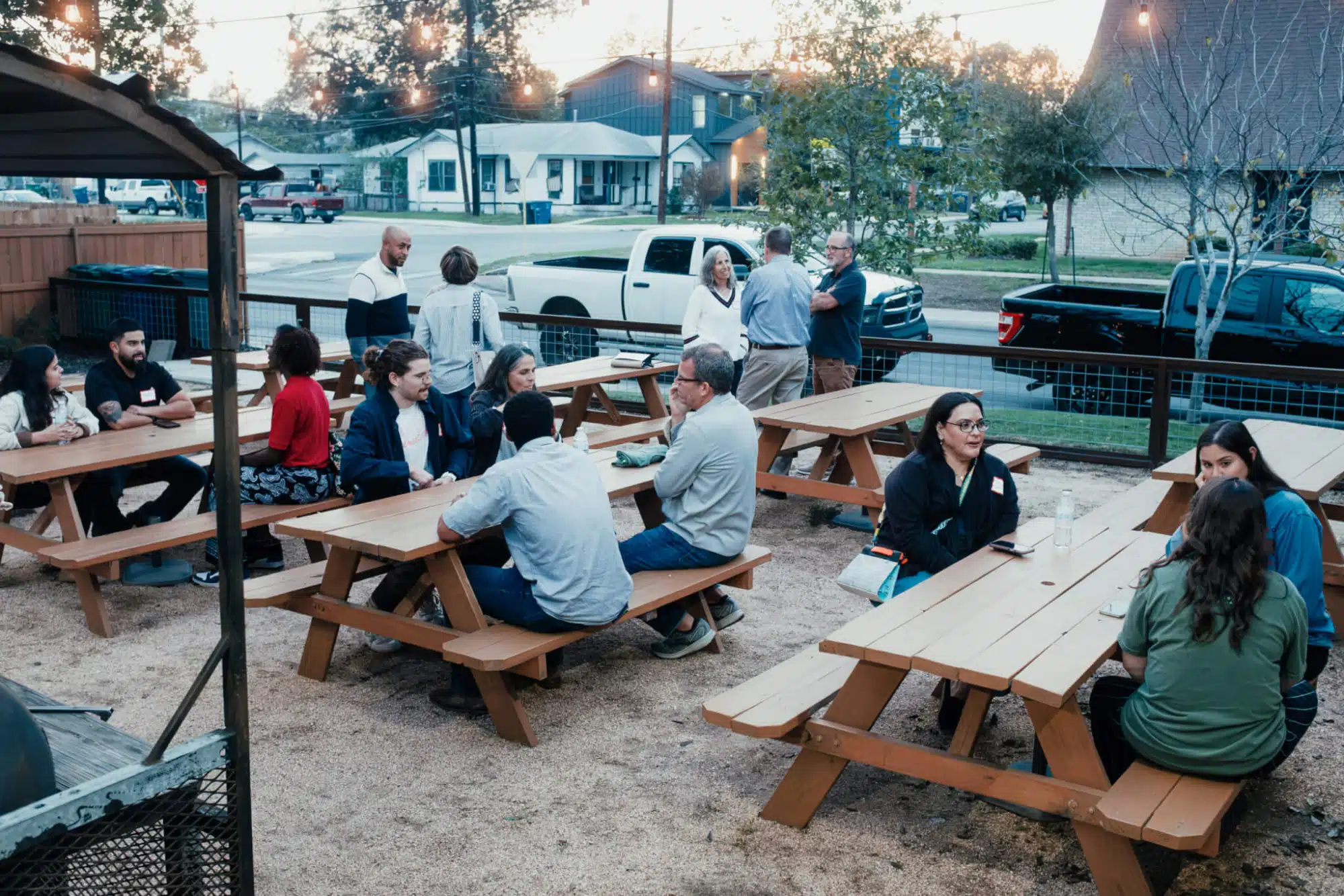
We do this on the regular at Know Your Neighbor, especially at our quarterly Shared Table events. We gather people from different neighborhoods—and their respective classes, ethnicities, life experiences—and pull them into conversations about the vast and troubling gaps in education, opportunity, and even life expectancy across different parts of San Antonio. These topics are tricky—the kinds we’d all like to avoid. But one of our convictions is that we ignore these topics at our—and our neighbors’—peril.
We ignore tricky topics at our—and our neighbors’—peril.
Another conviction is that great food and hospitality help it all go as well as it can.
Know Your Neighbor’s goal is to elevate and activate awareness of the realities of economic hardship in San Antonio. Many of us may be insulated from those realities—we might live in neighborhoods with high-performing schools, easy access to medical care, green space, fresh food, and so on. But the realities persist, so we create common tables where we can hear each others’ stories and grow bolder in acknowledging and seeking to understand the stories of our neighbors who live a couple ZIP codes away.
I love these tables, both in theory and reality. But hosting them isn’t easy. The conversations are unpredictable. Things can get messy. Often there is one person who has a lot to say and another person who barely says a peep. You suspect the one who has a lot to say would benefit from a lot more listening. You are pretty sure the quiet one has a story we all need to hear.
Great food and hospitality help it all go as well as it can.
Once, at a Shared Table focused on the challenge of housing affordability, I sat next to a woman of significant wealth. As two or three of our tablemates talked about the hard times they’d experienced with housing—evictions, constant moves in search of stability—I could tell she was tempted to turtle. Finally, I invited her to say whatever was on her mind.
“Well, honestly,” she said, “I wasn’t sure I wanted to be here tonight. The idea of ‘home’ for me has mostly been comfort and safety. I knew about homelessness, of course, but these stories of everyday people in our city … this just wasn’t on my radar.” She paused and looked around, seemingly bracing for everyone’s response, and maybe a tough word or two. But all she got was affirmative nods.
“I’m glad I heard your stories,” she added. “I needed to be here.”
That might seem like a small breakthrough, but we want to see small breakthroughs like that throughout our work. We see them most every time we hold events like this. In the last three years of the Shared Table program in San Antonio, over 70% of our guests say they made a meaningful connection with someone they did not know.
Check out the big quotes on the pages of this article—these are all direct quotes Know Your Neighbor event attendees have left on their surveys.
Do we also get negative feedback? Sure, and you can bet we pay attention to it. (Here’s one that made our team laugh at a recent meeting: “Our table needed more facilitation. Men talked too long.”) But the overwhelming tenor of the comments we receive is: I needed to know these things. I needed to know these people. And I’m carrying the knowledge forward.

The Bible has a lot to say about breaking bread with people, welcoming strangers, and building bridges across differences. Jesus’ three-year ministry was full of shared tables. You’ll recall that he was scorned for eating and drinking with people who others would prefer to despise or ignore. Indeed, in so many of his stories and actions, he went out of his way to make visible and lovable the very people that powerful interests did not think were worthy of his—or their—attention.
Lately, another set of Bible stories tend to come to mind for me as we do our work. I think about the Tower of Babel (Genesis 11), a story about people who had grown smart and savvy, people who put their technological chops to build a monument to themselves, one so great that it could reach the heavens. They had a single voice, single perspective, single goal: to obtain more, and to make sure everyone would know about their might. God responded by mixing up their languages, upending their pursuit of power.
We trust that we’re also living in a Pentecost world.
Then I think about Pentecost (Acts 2), where people from different regions and languages were together for a festival in Jerusalem. This time, God sends the Holy Spirit as tongues of fire—not to give the people one voice, but to help them hear and understand each other’s distinct voices so that good news could spread.
We’re living in a world that often looks more like the Tower of Babel story. Reckless ambition, feckless technological pursuit, and monuments to self seem to be the norm. But, to offer one final conviction, we trust that we’re also living in a Pentecost world. By the grace of God, we can yet hear one another and embrace news that’s far better than what the Babel builders have to say.
(Also, we will keep doing our best to make sure the men don’t talk too long.)