

Photography by Wendi Poole
A Laity Lodge speaker reflects on the empathy machine we need right now with 14 recommended films that build compassion and community.
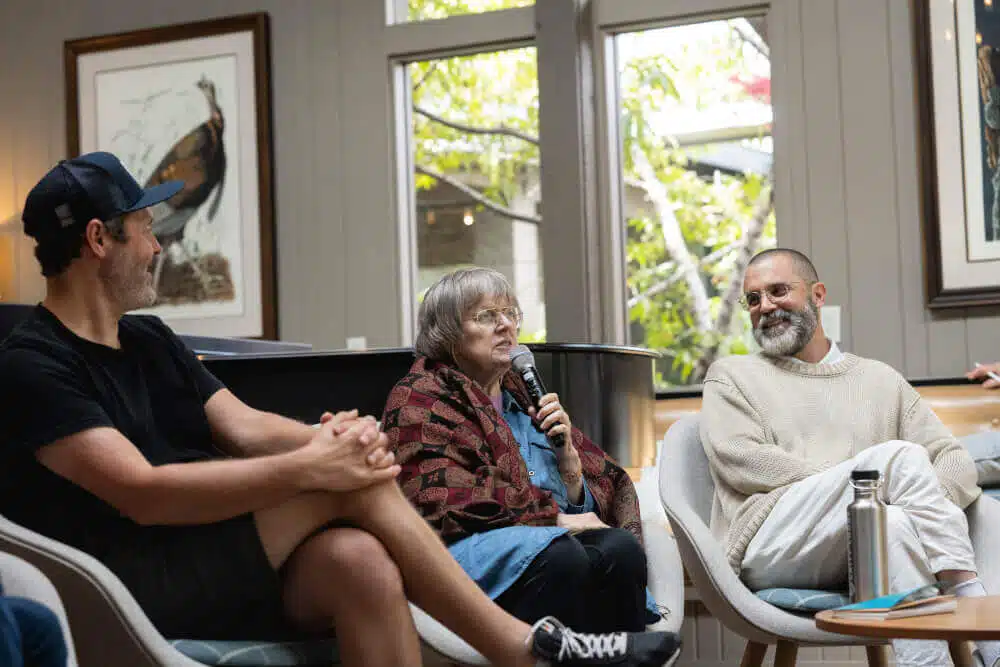
Something I treasure about Laity Lodge, that sets it apart from many retreat centers: They resolutely include music, visual arts, and film in their programs. These are communal endeavors.
My father, the son of a Methodist pastor, grew up in the 1920s, and his family shunned movies. Scandals involving actors and racy, often violent films had convinced many Christians that movies were an evil influence. By 1934, studio executives agreed to self-censor their films. Under the Hays Code, films were not to “lower the moral standard of those who see them,” or induce sympathy for criminals. The Code is the reason why, for many years, movies did not depict interracial romance, “sex perversion,” drug use, “women selling their virtue,” or even married couples sharing a bed.
It’s a different world now, for good and ill. I lament the gratuitous violence and overwrought sex scenes in many movies. But I agree with renowned actor Tilda Swinton, who says that film can be “an empathy machine…an invitation to step into other people’s shoes…a massive gesture of agape…” Even films that aren’t specifically religious can speak to our deepest spiritual needs. We are made in God’s image, and we need to connect with others who may be different from ourselves.
“Film can be ‘an empathy machine… an invitation to step into other people’s shoes… a massive gesture of agape.’”
This was a guiding principle for me and Gareth Higgins when we decided what films to include in our book, A Whole Life in Twelve Movies: A Cinematic Path to a Deeper Spirituality. We chose Malcolm X and Paterson because they explore how a person can discover their true vocation. We chose the documentary Faces Places in which 89-year-old French filmmaker Agnes Varda goes on the road with a 30-something hipster photographer. Together, they delight those they meet and demonstrate that creativity has no age limit. We chose Babette’s Feast, a bold assertion of the transformative power of hospitality and generosity.
I recently screened The Fisher King for a church group, another film in the book. It is the story of a deeply self-centered man who has an opportunity to help someone destroyed by his recklessness. The pastor and I had selected it as appropriate for Lent, and most who were present had never seen the film. Several people commented that it was good to watch the movie with others so that we could discuss our responses, especially regarding the severe trauma suffered by one character, and his long, slow road to recovery. Our discussion revealed an essential truth about cinema. Filmmaking is a communal endeavor, and movies fulfill their mission best when they are seen with others.
“Creativity has no age limit.”
At their best, films address our common humanity. Minari tells a story about Korean immigrants in Arkansas, yet it’s familiar to anyone who was raised in a family with tensions between parents and grandparents. Such tensions are always a mystery to the children. While love binds everyone together, those bonds can become frayed. The film reminds us that even after hardship and disappointment, love is what remains.
Our common humanity extends to other cultures as well. Consider the documentary Midnight Traveler made by an Afghan family on their cell phones. The parents run an artist’s and poet’s cafe in Kabul, and they flee Afghanistan with their two young daughters when the father lands on a Taliban assassination list. That threat makes the family eligible for asylum, yet their request is denied in several countries until they finally achieve refugee status in Germany. Despite these circumstances, their two spunky girls regard their travels as a grand adventure, enjoying morning birdsong after sleeping in the rough and marveling at their first sight of the sea.
“Filmmaking is a communal endeavor, and movies fulfill their mission best when they are seen with others.”
Some movies are simply inspiring, like the documentary The Antidote. The subtitle defines the film: Stories of Kindness, Decency and the Power of Community in America. The film visits nine inspiring places. An intergenerational village in Portland. A home for severely disabled people in upstate New York which has involved an entire small town in their care. A Texas college that helps its students graduate by assisting them with housing and utility costs. A program in a poor Indianapolis neighborhood that teaches teenagers to repair bicycles and provide them at low cost to residents. When I’ve shown The Antidote to church groups, I’ve been able to add some updates. The single mother struggling through college is now an RN. The man running the program in Indianapolis now travels the country teaching communities how to repair bicycles for their young people. People love hearing these updates, and they are grateful.
A final note about my father. When he was first on his own in Chicago, about to enter college, and had his first opportunity to see a movie, he went to three films in one day. It was 1935, so he had some great films to choose from: Top Hat with Fred Astaire, The Bride of Frankenstein, Anna Karenina, Mutiny on the Bounty, the Marx Brothers in A Night at the Opera, and the spy thriller The 39 Steps. This sudden immersion in cinema didn’t cause my father to lose his faith. He became a musician and for much of his life was employed as a church choir director.
“While love binds everyone together, those bonds can become frayed. The film reminds us that even after hardship and disappointment, love is what remains.”
Fourteen Films That Build Empathy and Community
Movies help shape our spiritual lives. Here are fourteen recommendations and why they matter, including seven classics from 1935. Most are available online for rent or streaming.
1. Malcolm X
A sweeping portrait of transformation, conviction, and the search for true vocation.
2. Paterson
A gentle meditation on poetry, routine, and the beauty of quiet purpose.
3. Faces Places
Documentarian Agnès Varda hits the road with a young photographer to explore creativity across generations.
4. Babette’s Feast
A tale of generosity and grace, where a single meal becomes an offering of love.
5. The Fisher King
A wounded man finds a way back to wholeness—with the help of another broken soul.
6. Minor
A Korean-American family plants roots in Arkansas, learning that love often grows through hardship.
7. Midnight Traveler
Filmed on cell phones, this documentary follows an Afghan family’s courageous escape from the Taliban.
8. The Antidote
Stories of kindness and community across the U.S.—from bike shops to college campuses.
9. Top Hat
Classic Hollywood elegance with Fred Astaire.
10. The 39 Steps
A spy thriller that’s long outlasted the Hays Code era.
11. Anna Karenina
A moral drama with timeless questions about love, society, and sacrifice.
12. A Night at the Opera
The Marx Brothers in peak form—chaos, comedy, and commentary all rolled into one.
13. Mutiny on the Bounty
A story of justice and rebellion that still resonates.
14. The Bride of Frankenstein
More than a monster movie—it’s a window into isolation and identity.