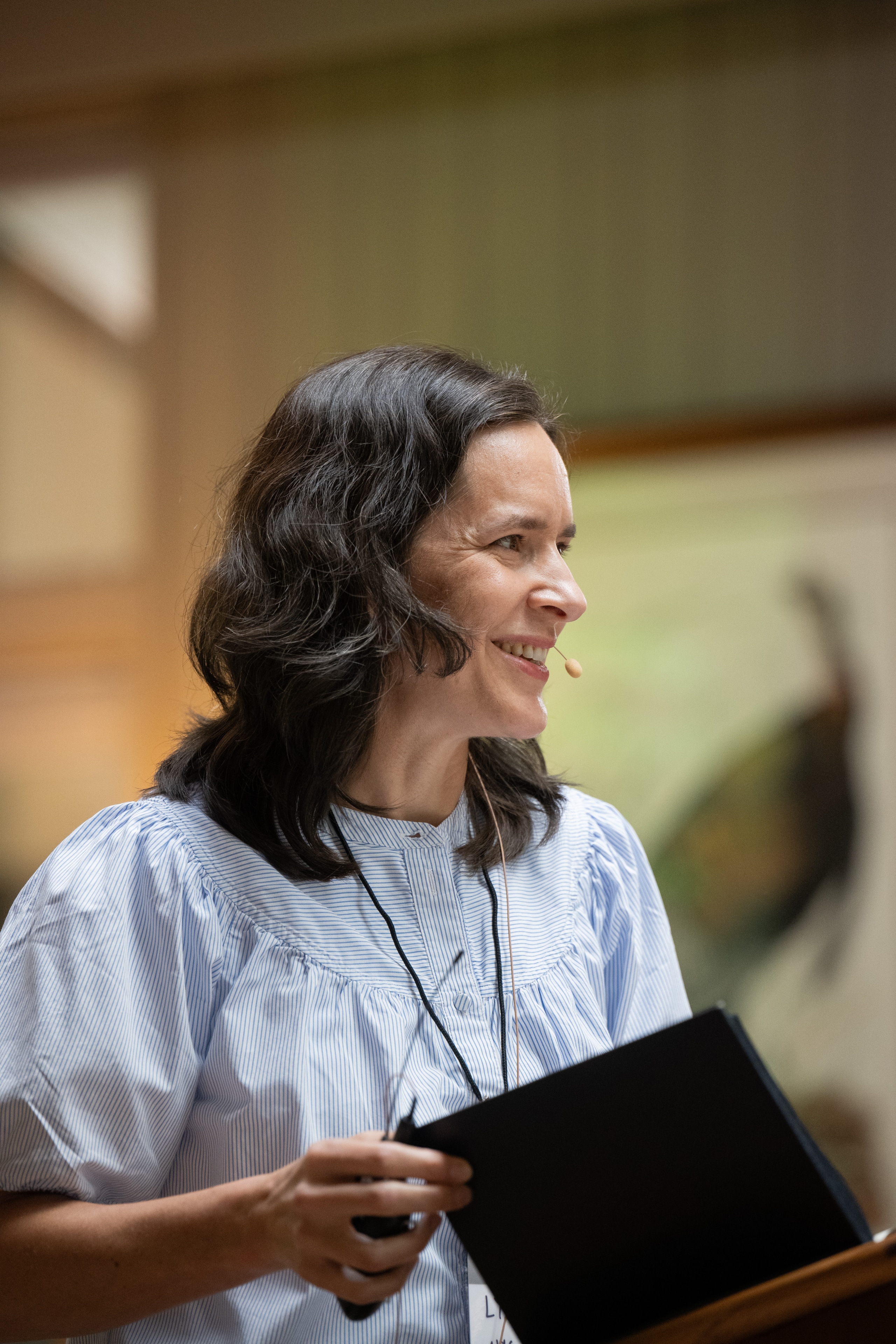


Physician and medical ethicist Dr. Lydia Dugdale (Columbia University) argues hope isn’t a careless wish—it’s a practiced habit oriented toward a future good that’s hard but possible. We talk about hope as a communal discipline, the dangers on both sides—despair and false hope—how doctors actually handle prognoses, why imagination relates to hope, and whether “AI grief avatars” help or harm. Along the way: Aquinas, Augustine, and Howard E. Butt Jr. advising us to stay “steady in the saddle.”
Watch The Podcast
- Hope You’re Well! No, But Really. – Echoes Magazine
- Lydia S. Dugdale, MD | Division of General Medicine
- The Lost Art of Dying – HarperCollins
- Between Presumption and Despair: Augustine’s Hope for the Commonwealth | American Political Science Review | Cambridge Core
- SUMMA THEOLOGIAE: Hope, considered in itself (Secunda Secundae Partis, Q. 17)
- Echoes Magazine
- H. E. Butt Foundation
00;00;00;00 – 00;01;41;17
Camille Hall-Ortega
One of my favorite things to do is to listen in on my kids as they play. They create magical worlds of make-believe, all while sitting in their playroom or running around in our backyard. I hear them say things like, pretend we’re in outer space, or this time I’m going to be the dragon. And as I listen, the moments warm my mama heart for innumerable reasons. They’re getting along. They’re having fun. And they’re reminding me just how powerful the gift of imagination can be. I pray they carry that gift with them forever. Because imagination continues to be crucial throughout our lives. In fact, it’s sometimes said that imagination is a key component of something else that’s very important. Hope. Because when we hope, we hope for the good, we can imagine. Today we’re talking all about the concept of hope. What is hope? And why does our guest today note it as more than a careless wish? But rather something that is fundamental to our health from age. From the H. E. Butt Foundation, this is The Echoes Podcast. On today’s episode, we welcome our guest, Dr. Lydia Dugdale. Lydia is a professor of medicine and the director of the center for Clinical Medical Ethics at Columbia University. She also studied at Yale Divinity School, a practicing medical doctor, Dugdale studies hope and end of life issues. She’s the author of The Lost Art of Dying and has a forthcoming book on the theme of hope. She’s also recently led a Laity Lodge retreat all about how to hope well. We’re thrilled to have her here today. I’m here with my co-host, Marcus Goodyear.
00;01;41;24 – 00;02;03;20
Camille Hall-Ortega
Welcome, Lydia.
Dr. Lydia Dugdale
Thanks so much for having me.
Marcus Goodyear
We’re glad you’re here.
Camille Hall-Ortega
Lydia, there’s so much here. I think most folks listening will immediately understand how relatable the concept of hope is, but also how complex this concept of hope is. And I think the place to start just be. What is hope? Can you help us with a definition for hope?
00;02;03;22 – 00;04;04;21
Dr. Lydia Dugdale
So hope is actually a rather complicated topic once you start to unpack it. And I spent about a year reading different philosophies of hope and theologies of hope to try to arrive at an explanation or a definition of hope that I thought did the most work for the broadest audience, in the best way possible. So let me start with that preamble. So that the definition of hope that I arrived at, draws heavily from Thomas Aquinas, but is not exclusively, Aquinas’s account of hope. It sort of blends, as some other some other ideas. But here’s how I define it. Hope is the habit of orienting and reorienting and reorienting toward a future good. That is not exactly clear at the present moment. That is difficult to achieve, yet possible to achieve. So it has all of these elements. It’s future. It’s good. It’s possible. Right? We don’t long for orient toward goods that are completely impossible. Right? So it has to be within the realm of possibility. But it’s also not something that’s just handed to you, right? We don’t orient towards future goods that are right in front of us. Right. So, there’s a certain amount of struggle in working toward hope. And I like this idea of hope as a habit. Or the ancients would use the word virtue. This suggests that this isn’t something just given to us. Actually, we’re talking about the kind of hope you have to work at. And, the really great thing about this sort of idea of hope as a habit that one works at is that it gives us some agency in the process.
00;04;04;23 – 00;04;29;25
Dr. Lydia Dugdale
Not only we ourselves, but also our communities.
Marcus Goodyear
What does it look like to work at Hope?
Dr. Lydia Dugdale
Yeah. So the ancients would say virtue is synonymous with a habit which is synonymous with an excellence. These are things that, one practices again and again and again. So, for example, Aristotle in the ancient world would say to have the virtue of courage.
00;04;29;28 – 00;05;02;23
Dr. Lydia Dugdale
You have to be thoroughly courageous inside and out. And what does this mean? This means that you practice courage. If you want to be courageous, you do courageous acts. And in the process of doing courageous acts, one’s character is transformed into one who is courageous.
Camille Hall-Ortega
Lydia, it sounds kind of like exercise, like we’re needing to create these habits and kind of a regimen of exercise that kind of strengthens our hope muscles.
00;05;02;23 – 00;05;25;28
Camille Hall-Ortega
Is that way off or is that that’s it?
Dr. Lydia Dugdale
That’s it exactly. Yeah.
Camille Hall-Ortega
I’d love for you to talk a little bit more about how hope is a communal work. What does that mean?
Dr. Lydia Dugdale
Yeah. So it’s interesting. I, I think as a Christian, I can’t help but think about hope as what one poet calls the middle sister between the two older sisters of faith and love.
00;05;26;00 – 00;07;07;00
Dr. Lydia Dugdale
Okay. And so on. That accounting, what is the relationship between faith, hope and love? Hope is in the middle. And I’m just going to answer your question, but I’m going to do so by way of faith. Then it’s great. And that’s great. So in the Greek, the word for faith is pistis (πίστις), which actually in the ancient world was used synonymously with the evidence that would be presented in court. So you knew that you would win a court case because you had faith, you had the pistis, the evidence that would support the claim you were making. Okay, so if hope is the middle term between faith and love, then faith is looking backward and saying, “I know that a future good will come even though I can’t see it right now because I have evidence. I have proof in my life that even when all hope seemed to be lost, actually good did come.” And so faith is a way of looking backward to give us the foundation, the stability, to know that we can hope going forward. Okay, so that’s the relationship between faith and hope. Love. Then it’s a two way street. So when we become people of hope, we can then be agents of hope or surrogates who hope on behalf of the hopeless around us, on behalf of the despairing and our communities.
00;07;07;02 – 00;07;33;15
Dr. Lydia Dugdale
But when we ourselves are incapable of feeling hope, of practicing hope, of exercising hope, then those of us embedded in communities can draw on that. The hope that has been cultivated by our communities, by the people in our communities, to hope on our behalf. Does that make sense?
Camille Hall-Ortega
Absolutely. It’s beautiful, really, that there’s this leaning on of each other in community, in this context of hope.
00;07;33;15 – 00;07;55;21
Camille Hall-Ortega
That’s really gorgeous. Thank you.
Marcus Goodyear
I don’t know if I should say this or not, but I’m, I’m in Kerrville and we’re dealing with community trauma here. There were some floods this summer, and it was rough. So, I am thinking right now of some of the communities I’m in right now. If I were to turn to those communities for hope, they might not have much resources for me.
00;07;55;27 – 00;08;16;10
Marcus Goodyear
And I think that that’s probably something people encounter, whether they’re in a community that provides hope for them for a time, and then something in that community breaks or becomes dark and it ceases to be a hopeful support for them. So how do we how do we remain beacons of hope for our communities, when maybe our communities don’t have that hope themselves?
00;08;16;12 – 00;10;18;19
Dr. Lydia Dugdale
Yeah, that’s a great question. And I, I know I was, down at Laity Lodge just the week after, the flooding in Kerrville. And, to be there was such an honor at that time. But also so hard. And it really brought into relief the need to think clearly about hope. What I’ll say is that there is a real give and take in all human relationships where circumstances change, trauma presents itself. Mental illness strikes a physical illness strikes. You know, I’m a physician. That’s what I know really well. And the person who may have been the one who had best cultivated, a habit of hope may, in a season, not be that person who can hope, well or hope on behalf of others. We can’t just rely on one person to be. Oh, she’s the one who hopes for our congregation, right? But one body, many gifts. But we also, I believe, all need to be working at this process of cultivating the gifts that we might not naturally possess. Right. So again, going back to the ancient world, you know, there’s some debate in the ancient world about whether the truly virtuous person needed to possess all virtues. And some thinkers thought you did, and so you might not be naturally disposed at all toward hope or toward courage or toward patience. But that doesn’t mean you don’t work at them. We can look around and see what sorts of traits we are called upon to inhabit, to adopt, to cultivate. And if we aren’t those kinds of people, then we do need to be working at that and not just rely on someone else who might be so inclined or so disposed.
00;10;18;21 – 00;10;56;20
Camille Hall-Ortega
Right? Lydia, you mentioned just a bit there about this concept of hope in a context that is, of course, quite salient for you, which is in the health context or in the context of medicine. Can you talk a bit more about how you see hope come into play in your practice of medicine?
Dr. Lydia Dugdale
Yeah. So I you know, I have two earlier books, both on preparing patients for death and in the process of doing hundreds of book talks, especially on the latter book, a theme that came up again and again is, okay, so you keep saying we’re all going to die.
00;10;56;20 – 00;12;53;03
Dr. Lydia Dugdale
We know we’re all going to die, but then what is hope? And it’s interesting because Saint Augustine talks about hope as being the middle term, or the golden mean, or the average between two extremes. On the one hand, you have despair, which is etymologically so. The word itself means lack of hope. That’s what despair means. So yeah, another way to put this is a deficiency of hope gives you despair. But on the other extreme, there’s the excess of hope. And what is the excess of hope? While Augustine would say excess of hope is presumption. But I think a better way to characterize it is false hope. And so I see this in the clinical setting all the time. I have patients who get the terrible diagnosis or who are told that, you know, their prognosis is terminal, but there’s nothing else that can be done. And those patients often are prone to hopelessness, to fall into despair. The deficiency of hope. But then there are other patients who reject that and say, no, no, no, no, no, I don’t believe you. I know that there will be a cure. I know that I’m going to leave the hospital alive. And that, I would say, is an excess of hope, a presumption or a false hope. And so that’s the way I see both. I would say probably. Well, it depends, I, it depends I, I think more despair in the community and maybe it’s half and half in the hospital, you know, half despair and half false hope. I think physicians, medical doctors themselves probably prefer false hope because it keeps us from having to be honest with patients and have those really hard conversations.
00;12;53;03 – 00;13;33;26
Dr. Lydia Dugdale
So if we can sort of, fuel or feed their illusions of false hope, then we don’t have to, do the really difficult work of helping them prepare and grieve and walk toward their certain end.
Marcus Goodyear
Wow. Yeah. What a job you have.
Camille Hall-Ortega
Yes, I can imagine. I’m just thinking back on my own experiences, and I can imagine you kind of see both sides of that, where some physicians might want people to be really hopeful and, and some, you know, maybe giving information that feels like it leads to people, you know, being more likely to be despairing.
00;13;33;29 – 00;14;51;17
Camille Hall-Ortega
I remember my grandmother, she had, cancer claim later in life, and she went many, many years and, and didn’t have really any symptoms. So they detected it early and so but then as the years started to go by, it was becoming harder and harder for her. And so she would have stints in the hospital. And I remember one time in particular, she went into the hospital and they ended up saying, okay, it’s time for you to go to rehab now. And I remember my mother was so upset one day and I said, what happened? And she said, this doctor came in and and basically said, like, count the days. This is, it’s it’s pretty much over here. The goodbye is coming soon. And he she said he was so negative and I didn’t understand where that was coming from. And I remember in that particular instance, my grandmother got out of the rehab and lived for several years after that. And so my mom really felt kind of vindicated in that. Like, you see, he had no business talking like that to me. But then I can also imagine his perspective, maybe thinking of how many times it didn’t go that way.
Dr. Lydia Dugdale
Yes. Well, I’m thankful for your family that your grandmother had some more years. Yeah. But, yeah, it’s, it’s so tricky.
00;14;51;19 – 00;15;16;25
Dr. Lydia Dugdale
We know from the data that doctors are horrible prognosticators. And at the same time, I do think, well, I do think good doctors want to try to help their patients prepare. Yeah, I think bad doctors often run away from the difficult conversations. Or they might be technically competent. But, you know, I think good doctors are walking step in step with their patients.
00;15;17;02 – 00;15;44;25
Dr. Lydia Dugdale
And then you have it’s often the young doctors who want to be brutally honest because they think that’s what they’re supposed to do. But haven’t quite learned that maybe finer art of relaying this information gracefully.
Camille Hall-Ortega
Finesse.
Dr. Lydia Dugdale
Yeah. That’s right. But yeah, it’s a it’s a very it’s very tricky. And because, well, because we’re poor prognosticators and because the unexpected does happen, I mean, miracles do happen.
00;15;45;00 – 00;17;27;17
Marcus Goodyear
So, Camille was talking about her, her grandmother, I, my father-in-law died during Covid. Not of Covid, but it was very fast. The prognostication was accurate, unfortunately. But it was still sort of beautiful because he knew what was going to happen and somehow was hopeful. So, I learned from him a tremendous amount during that process, and we’re a couple of years away. But I am starting to see people grieve differently than I had an opportunity to. You have mentioned this. It’s a little far out, but this idea that people are using AI to grieve differently. Can you talk a little bit about that and what you think of that as what advantages does it bring. And are there some downsides.
Dr. Lydia Dugdale
So you know AI is, is changing a lot of things. Yeah. But one, one tool that has become available is to, for example, take any audio or video that a loved one has ever made and feed it into an AI that can then generate an avatar of your loved one, where you can have conversations with your loved one. As if he or she was really there on the computer, right? Having a conversation with you.
Marcus Goodyear
But it’s like a video avatar.
Dr. Lydia Dugdale
Yeah, it’s like a video avatar. We already have these sorts of we’re using this sort of technology in many different ways. But, you know, this is yet another way that it’s being use it in a sense, it doesn’t memorialize your loved one, in in memorializes a loved one.
00;17;27;17 – 00;19;13;00
Dr. Lydia Dugdale
Right. Because this is now someone who isn’t dead. Here you are. You’re having I mean, they’re dead, but you’re here having a conversation just as we’re having a conversation now, looking at them through the screen, they’re saying everything that they would say, as if you were actually talking to them when they were alive, using the same voice, making the same mannerisms, etc., etc.. And so, you know, look, I don’t know data on this, but my sense is that maybe this helps people grieve. Well, I don’t think we know yet. Really, I don’t think I think it’s too early to say. We do know that it’s very normal for up to about a year after someone dies to hallucinate that you’re hearing them, to dream about them, to think, oh, wait, mom, you just oh, no, mom’s not here. Right? That’s sort of a phenomenon where you. Yeah, and it’s as though they’re they’re they’re such a part of your consciousness that you feel like you’re always about to, to reach out to them, or they’re always saying something to you. That’s normal. That is a normal part of the grieving process. And usually what patients describe to me is that that experience of if we want to call it hallucinations, I don’t think that’s actually quite the right word, but that what feels almost like a hallucination. Hallucination? I thought I heard my loved ones voice, that tends to fade with time. Now, I don’t know how that will change. If you have the avatar sitting in your laptop talking to you every night over dinner, I think it’s too early to say totally. If this is going to mess up the the natural grieving process, but it certainly will disrupt it, disrupt natural grieving.
00;19;13;02 – 00;19;50;27
Dr. Lydia Dugdale
But whether it’s it’s harmful is too early to say.
Camille Hall-Ortega
Wow, what my first reaction to just even the thought of that is, gosh, that feels strange. And I think it’s mostly because of of what you’re saying, that it’s not what’s meant to be happening. Right? Like that’s not the natural course of things. And I wonder if there will be I imagine there would be some physiological consequences, almost like, couldn’t you develop a dependency on, you know, I’m just thinking of the, the downsides like that that could begin to feel like a hit from a drug, you know.
00;19;50;29 – 00;20;19;16
Camille Hall-Ortega
Oh yeah. And I think, gosh, that I, I imagine the dangers and the downsides are there are pros that you can imagine in that context.
Dr. Lydia Dugdale
I think it does sort of ease their pain. Right? I mean, in the same way I think now of, I don’t know, maybe it’s just movies of, you know, the glory days on the battlefield where the guy takes out the photograph of his wife and, you know, kisses her well.
00;20;19;19 – 00;20;43;24
Dr. Lydia Dugdale
Right. Is there a way in which that avatar is, in a sense, helping to soften the grief of, of separation and death? Just like that photograph in your in your pocket on the battlefield?
Marcus Goodyear
Might, might have done that perhaps. Yeah. It it makes me think of the uncanny valley. You know, this idea that the closer something gets to being human, it’s.
00;20;43;24 – 00;24;36;27
Marcus Goodyear
I first learned about it with robotics that the closer a robot is to almost human, the more likely it is to feel like a zombie or like a corpse. And so when I have a sorry, this is a little dark, when I have a photo on the battlefield, like there’s no mistaking the photo for my loved one. I understand it as a representation, but when I have a real time, realistic animation of my somebody who is close to me, who is now dead in my computer in a way that I have seen them there before when they were alive, it feels like we’re crossing into some some kind of uncanny valley, although maybe it’s not even uncanny, it’s just confusing. I don’t know if to me it feels somehow dishonest and in a way that is new, but maybe I’m just being cranky about technology, I think.
Dr. Lydia Dugdale
I think you’re right. So, a colleague of mine. Yeah, we’ve just I’ve just been at an AI conference. A colleague of mine was talking about how in traditional religious iconography, there’s often a flaw that’s introduced in the into the icon, as if to tell the viewer this is not reality. You can see there’s a flaw. This is not this is not the person himself. This is just an icon. This is just an image. Yeah. And one of the tensions with the AI programmers who are developing this technology is that they don’t want to have to introduce flaws into their avatars, because the flaws suggest imperfection in their work. And yet then it does. It is inauthentic. It’s deceptive. Right. It’s I think I’m actually talking to Marcus Goodyear, but in fact, I’m just talking to some sort of generated, avatar of Marcus Goodyear. That’s. Who are you? Really? What? Who with whom and not really speaking. Is this even a conversation? This isn’t to human beings, right?
Dr. Lydia Dugdale
It starts to just really spin out of control. But there’s a tension because the technology designers do not want to introduce flaws for the sake of ensuring that this is simply technology and not reality. So there’s a there’s a reticence to make the distinction between reality and fiction clear.
Marcus Goodyear
It feels like we’ve, we’ve drifted away from hope.
Although I’m very curious to hear you talk about just the ways in which people are placing very strange hope in AI. Have you experienced that as well, or am I?
Dr. Lydia Dugdale
Well, so. So if we want to take this back to my work on hope, I will say this, that I think it’s very important to distinguish between hope in an object or a person, and hope as a fundamental orientation toward a future. One is a posture and one the latter is a posture, this orientation toward a future good. It’s a disposition. It’s a habit. Whereas when I say I’m hoping in something, it’s putting all of the weight, all of the work into the object of my hope. And that object has to then be able to do that work. And as Christians, we would say no object can do that work, right? Only God can do that work. And that’s why it’s very common for Christians to say, well, I hope in God my hope is God. My hope is Jesus. Right? And so there’s a way in which we could say of AI, if my hope is in AI, AI cannot do the work of bearing all of our existential, all of our eternal, ultimate questions.
00;24;36;27 – 00;24;59;10
Dr. Lydia Dugdale
I cannot, cannot hold those. I can do some really cool stuff. It’s a great tool. It’s a great research assistant. It’s great at confusing us and sending us down a rabbit hole. Yes, I can do some really, really phenomenal things. But AI is not God and will never be God.
Marcus Goodyear
I mean, I feel like you’ve you’ve cued us up here.
00;24;59;10 – 00;26;49;03
Marcus Goodyear
We have an audio clip from 1982. This is Howard Butt Jr. again, he’s a he’s a voice we hear from time to time because, we are the H. E. Butt Foundation, sponsored by the H. E. Butt Foundation. And, that means Howard Butt Jr. . So he used to speak at Laity Lodge. He helped start Laity Lodge. And, here he is talking about hope in, in a very similar way from 1982.
Howard Butt Jr. Audio
Apart from hope, what happens is we fall off one side of the horse or the other. We fall into despair, or we go to the other extreme and fall into presumption. This is the manic side where too high or this is the depressive side, we are to too low. The problem of life is to avoid the extreme of presumption or despair. And that’s what hope offers us, because hope does not fall off the horse on either side. Hope sits steady in the saddle. Hope has it all together. It is neither to up or to down.
Camille Hall-Ortega
We’ve heard a lot of that sentiment from you, Lydia. What are your reactions to that clip?
Dr. Lydia Dugdale
Yeah, I love that. I think he totally hits the nail on the head. I had never thought of despair as well. I had thought of despair as a kind of depression, sure, but to think of false hope or presumption as mania was definitely a novel thought for me.
00;26;49;03 – 00;27;38;02
Dr. Lydia Dugdale
But he, Howard, captures it really beautifully. What Augustine said, which is that hope is the mean. It’s the middle. It’s sitting on the horse between the extremes of despair and presumption or false hope. And how do you sort of stay on the saddle? I mean, the beautiful thing is that I think there’s a little bit of there’s for all of us, there’s a little bit of jostling in the saddle. Right? Sometimes we are leaning a little bit towards the despair. Sometimes we are leaning a little bit too much toward expecting it to go the way we think it should go, and it better go that way. And so it’s okay that we’re not sitting perfectly on the saddle as we should be, but if we’re just sort of, you know, sliding away from hope in one direction or the other and we can course correct.
00;27;38;02 – 00;27;57;24
Dr. Lydia Dugdale
Then we get back on the saddle.
Camille Hall-Ortega
Lydia, we heard, you know, even from some of the AI stuff that we were discussing, but just in general that obviously, especially in the medical context, some of us can get a little bit dark. There can be times when it’s, you know, some of this is kind of sad to talk about.
00;27;57;26 – 00;28;35;14
Camille Hall-Ortega
I’m curious, just kind of on a personal level, what it’s like to study death and dying is that does that take a personal toll?
Dr. Lydia Dugdale
No, not really. Yeah. That’s good, that’s great. That’s good news. Yeah. So here’s the thing on, well, there’s several things I do think people who think about these questions sort of routinely are probably more comfortable just based on personality type, disposition, upbringing, all of those things.
00;28;35;17 – 00;31;23;17
Dr. Lydia Dugdale
So, I grew up in a household where my grandfather had been a bomber pilot. He had a plane crash during flight school. He was shot down during World War Two. He was taken prisoner of war. He was in one of the worst prison camps in Europe, before finally being released. Had lifelong, medical problems because of what happened to him in prison camp. Anyway, but he was also a very hilarious man, and he was always joking about, being on good terms with The Undertaker. And he’s going to have coffee with The Undertaker. And if any of the grandkids got a tattoo, he was going to write the grandkids out of the will. And, you know, so everything was this constant conversation about sort of the exuberance of life mixed with the reality of death. And he was making jokes about it all the time. So I grew up in that context, and I thought that was normal. And then I got into medical training and realized, oh, wow, so many of my colleagues don’t even want to talk about death. Oh, I had a colleague say, oh, I don’t know why you think about death. I do everything I can to avoid talking to my patients about death because I myself am so afraid of death. I have read physician writers who describe their drive to study medicine was motivated in large part because of their own death anxiety. They needed to study the body to be able to master the body, because they themselves are so afraid to die. So my upbringing then, isn’t the norm for people in medicine. I came to realize. But the flip side is that because I was comfortable thinking and talking about death, and because death is the great equalizer, right? Every single one of my patients will die. Yeah, every single one of us will die. It made sense to try to help prepare my patients, because it turns out that so many of them were coming into the hospital woefully unprepared. Yeah, with, relationships they wished they had mended. But now they’re sick and dying, and it’s too late with religious questions. They had avoided their whole lives, but now they’re sick and dying and it’s too late. And now I’m assigned as their doctor in this very unfortunate setting, and they’re often not with it enough to even be able to do the work of preparing for death. And so I thought, well, let me start alerting people to the fact that if you want to die, well, you have to live well. And those two go hand in hand. So for me, the work of preparing patients to die well is actually a very hopeful kind of work, because it means they live such better lives. So good.
00;31;23;17 – 00;31;45;22
Camille Hall-Ortega
I think that’s kind of the, the way to frame it in this really positive way that I think it’s really helpful. So thank you for that. You have we’ve heard you speak a little bit about how imagination plays into hope, and I would love to hear more about that.
Dr. Lydia Dugdale
Camille, I know you have thought about kids playing imaginatively.
00;31;45;26 – 00;33;18;21
Dr. Lydia Dugdale
Yes. But actually most children, when they make believe play, they make believe things that they have seen their parents do. Yeah. So you play house, you play school, you play doctor, you play, you know, railroad trains. You’re iterating on things for which you have knowledge. Yeah. It’s very rare for a child to make believe about something that they’ve never been exposed to, of which they have zero knowledge. So some psychologists say you can’t imagine if you don’t have knowledge. So if you really want to expand your imagination, you need to gain more knowledge. I think this is mostly true. But then we have these prophetic, mystical, poetic experiences in our tradition that suggest that sometimes there can be inspiration given that is otherworldly from the divine, cosmic whatever. And then we have to make space for saying, well, sometimes imagination can be stretched not by your own acquisition of knowledge, but by something being sort of imposed on you from without. Yeah. So that’s why I want to make space for that. But generally the thinking is, yeah, we and this is even what Albert Einstein said that you need to expand your knowledge base in order to expand your imagination.
00;33;18;23 – 00;33;40;17
Camille Hall-Ortega
Really really good.
Marcus Goodyear
Does that also expand our hope so. Right.
Dr. Lydia Dugdale
So if hope is the orientation toward that future good. That is ill defined. Right. We’re not exactly sure what it is. We know that we need some future good. Right. Whatever our circumstances are now the world is collapsing I don’t know. Yeah I know the the country is becoming more divided.
00;33;40;17 – 00;34;28;22
Dr. Lydia Dugdale
Whatever you want to name, you know, a loved one is diagnosed with disease X, whatever it is that makes it feel like our world, my world is collapsing and I need to orient toward that future good that is difficult yet possible to achieve that is ill defined. While imagination then helps us begin the work of of in a sense, testing. Right? Could it be this? Is this the good that will come? Could it be this good? Could it be that good? And it expands our capacity for hope? Well, with an expanded imagination, maybe you can see 10 or 15 different futures. Not exactly sure how it’s going to be realized, but that gives you substance for leaning in toward this future good rather than having no future.
00;34;28;24 – 00;35;27;04
Camille Hall-Ortega
Lydia, all of this is so good. I wonder if, as we wrap up, there’s just kind of a word of encouragement. I know you’ve spoken about hope as the long game and you’ve just talked about endurance. What do you say to folks who say, you know, I’m trying my best to hope I’m pretty tired? Whatever my situation is, I’m pretty tired. You have a word of encouragement for them.
Dr. Lydia Dugdale
Hope is the long game. Life is a race. But we also don’t run alone. And that’s the piece right. We are on a team and we need one another. We need the church, we need the Lord. And so yes, running the long race is so hard and you will have uphill moments and you will have downhill moments and you will have moments when that, you know, cramp in your side or in your calf muscles is just too much to keep going.
00;35;27;09 – 00;35;53;06
Dr. Lydia Dugdale
Right. And that’s when somebody comes along side and says, keep going, keep going. I’m with you right? And even when there’s not a human being saying that, that’s the beauty of the Holy Spirit. Yeah. I won’t leave you or forsake you. Right? I’m here running alongside you.
Camille Hall-Ortega
Beautiful. Lydia, we’re so grateful for your time. Thank you so much for everything you’ve shared.
00;35;53;13 – 00;36;17;15
Camille Hall-Ortega
We appreciate you.
Dr. Lydia Dugdale
Thank thanks so much for having me.
Camille Hall-Ortega
The podcast is written and produced by Marcus Goodyear, Rob Stennett and me, Camille Hall-Ortega. It’s edited by Rob Stennett and Kim Stone. Our executive producers are Patton Dodd and David Rogers. Special thanks to our guest today, Dr. Lydia Dugdale. We recently featured Lydia in Echoes magazine, and you can read the article online at echoesmagazine.org.
00;36;17;18 – 00;37;21;04
Camille Hall-Ortega
While you’re there, consider subscribing. You’ll receive a beautiful print magazine each quarter, and it’s free. You can find a link in our show notes. The Echoes Podcast and The Echoes magazine are both productions brought to you by the H. E. Butt Foundation. You can learn more about our vision and mission at hebfdn.org.