

How the project’s 501 public housing units would be redistributed under a SAHA proposal and what that would mean for current residents.
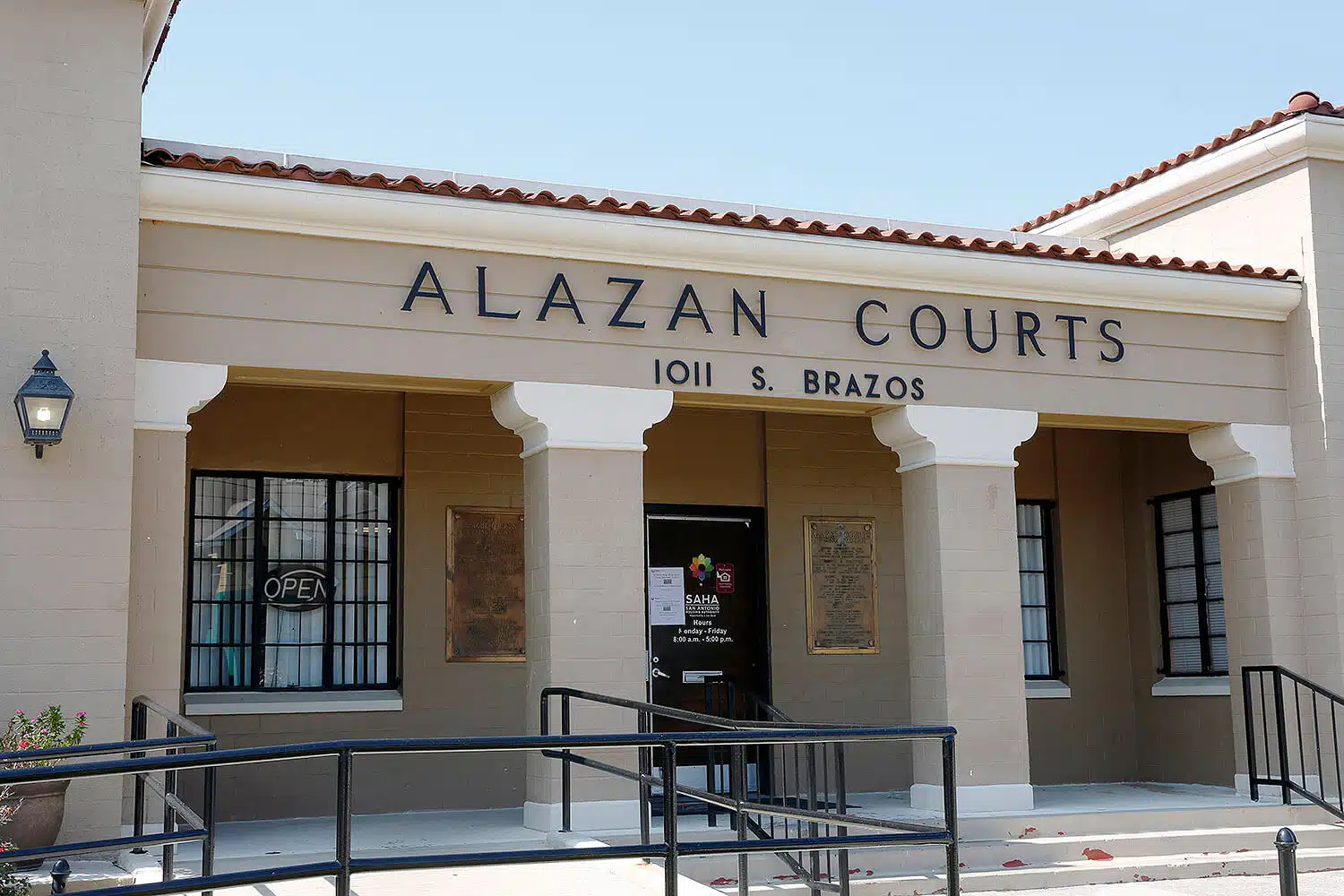
It’s easy to get lost in the much-discussed proposal to revitalize the Alazan Courts, the 77-year-old public housing community just west of downtown. The plan, being put together by the San Antonio Housing Authority, is complex.
To put it simply, the proposal wouldn’t rebuild the Alazan Courts. It would eventually replace the aging cluster of concrete and brick buildings with a mixture of public housing and market rate units. In other words, a completely new community.
The proposal for Alazan Courts, where the median household income is $10,242, seeks to accomplish two goals:
First, it gives current residents the opportunity to move away from the courts, and the near West Side, by offering public housing options in three strategic areas. Or, they can choose to stay on the current site, SAHA officials said. Another option is the Section 8 voucher, which the resident can take to any part of the city with Section 8 housing.
Second, it revitalizes part of 78207, which has been San Antonio’s poorest zip code over the years. The plan infuses millions of public dollars into the area closest to downtown that hasn’t yet felt the effects of the Decade of Downtown, former Mayor Julián Castro’s urban revitalization plan.
SAHA’s ambitious attempt would be kickstarted by a Choice Neighborhood grant — a federal subsidy worth up to $30 million. Applications are due to the U.S. Department of Housing and Urban Development on Nov. 22; the winners will be announced summer 2018.
Officials said procuring the Choice grant could leverage $200 million in additional investment. Area for improvement extend several blocks beyond the courts’ current footprint, and could include rehabilitation opportunities for those people who live near the courts.
For an example of the Choice grant in action, look to the East Side. There, the Wheatley Courts were demolished and are now being rebuilt as East Meadows — a mixture of public housing and market rate apartments. SAHA officials say they are taking some of the lessons learned from that project, and are applying them to Alazan.


What’s being built, and where
First things first: All 501 units that currently comprise the Alazan Courts aren’t going to be replaced on the current site — which abuts Alazan Creek and is bounded roughly by Cesar E. Chavez Boulevard, South Brazos Street and El Paso Street.
More than 50 percent of the current units will remain, SAHA said, but the others will be rebuilt in three other communities — the Medical Center; the far West Side, near Culebra and Callaghan roads; and south of downtown, near South Flores and Cevallos streets (which is actually the closest to Alazan; about a mile away.)
This gives options to the current residents who want out of Alazan, and the West Side, SAHA said.
Not replacing all 501 public housing units on site, and mixing in market rate apartments, helps remove the stigma associated with the courts, SAHA contends.
“We’re trying to deconcentrate public housing,” said Lorraine Robles, SAHA’s director of development services and neighborhood revitalization.
Another issue has to do with space. Residents want larger units, Robles said, and therefore there isn’t enough room to replace all 501 public housing units back on the site.
But some Alazan residents who have attended the public meetings remain confused. Some believed that the 501 units would remain on the current site.
“They did say they were going to match the housing unit for unit, but they didn’t really disclose or make clear the manner in which they were going to do it,” said Michelle Tremillo, 34, an Alazan Courts resident who has attended all of the public meetings. “Even with that, it still wasn’t clear to me a clear plan.”
Robles, the main SAHA official who often explained the plan to residents, defended the process and said duplicity was never intended.
“That was not the intent, nor do I believe that we did a poor job (explaining the plan),” Robles said. “We have been communicating with the residents since the inception.”
If the plan is hard to understand, Robles said, it’s partly because the number of units is a moving target, and will continue to be up until the application is submitted. SAHA must form purchasing agreements with the owners of parcels adjacent to Alazan that the entity wants to build on (mostly vacant lots, no homes, SAHA said) before the application is submitted to HUD. But if those parcels aren’t under contract, it changes the total number of units that can be built.
At the final public meeting, held last week, SAHA used a PowerPoint presentation to show 1,325 total new housing units — 685 on the current Alazan site; 160 on Snowden Road near in the Medical Center; 330 near Culebra Road and Mira Vista; and 150 near South Flores and East Cevallos streets. But, again, the delineation between public housing and market rate was not available, SAHA said.
In the case of Wheatley Courts, its 246 units were razed at once. Currently, the new community, East Meadows, is being built with many tenants already occupying apartments there. But 49 of the 246 units went to Sutton Oaks, a SAHA community less than a mile away.
This time, instead of demolishing the Alazan Courts all at once, phases of the new development will go up before the current tenements are razed. This will allow residents who want to stay in the community the ability to move once — into a newly-built apartment — before their current units are taken down. They can also move to the nearby San Juan property; or, they can move away — to one of the other sites or anywhere in the city via the Section 8 voucher.
Robles said in a community meeting last week that approach was driven by a lesson learned from Wheatley Courts.
“That was 201 families that we moved (from Wheatley Courts) and that was difficult,” Robles said. “To try to move 501, there was no way.”

Should I stay or should I go?
Some Alazan Courts residents want to stay, and some don’t. In either case, SAHA will provide its 1,200 residents with case management — with the goal of improving educational outcomes, job readiness, health and wellness and even small business ventures.
Arnulfo Vela, 73, has lived in the area’s public housing for many years and says he doesn’t want to leave the West Side.
“I don’t want to move from this area . . . I know how to get everywhere, from the VA and my doctor’s downtown,” Vela said while relaxing outside his home at the Alazan Courts. He’s only lived there for about 18 months, but he lived at the Apache Courts, just on the other side of Guadalupe, for 10 years.
“I know which buses I have to catch to get to where I have to go to, and you get used to it.”
Velia Pinero, 68, has lived at Alazan for 22 years.
“Just fix the apartments, in my opinion,” Pinero said in an interview at one of the public meetings. She said public dollars should be spent on education — on helping the Alazan kids who attend Lanier High School and Tafolla Middle School, which flank the courts to the west and north, respectfully.
More than 600 children live at the courts, according to SAHA. And roughly 50 percent of students are not passing required state tests.
“It’s a waste of money in my opinion,” Pinero said. “I don’t know, maybe I’m wrong.”
Then there are some of the newer residents, who seem to want out of Alazan as soon as possible. Some see the Section 8 voucher as an opportunity to move to a safer neighborhood.

“If this was a chance to get (the voucher) I would get it and move somewhere else,” said a mother of three in her 20s, who wished to remain anonymous. “I have three small children. I can’t even let them go outside without someone coming up to them and scaring them.”
When asked who would scare her children, she said, “Drug addicts. Random people who come off the street and from the bridges and they are all high. And they walk up and they’re just staring at the kids playing. Or they ask, ‘Is your mom home?’ — ask if they can sell you something to give them their fix. It’s really ridiculous.”
Tremillo, also a mother of three, agreed that the Alazan Courts attracts many transients.
“I live on San Fernando Street and it’s like a highway for them,” she said. “I’ve personally seen a man behind the dumpster holding something behind his back like he was waiting for somebody.”
Tremillo lived at the Apache Courts, which are not included in this Choice grant application, for 10 years before moving to Alazan two or three months ago.
“If we’re just purely looking at the structural problems, then yes (demolishing the courts) is a good idea,” she said. “In my opinion, it’s not going to help (with) the people that are causing the problems . . . it’s just going to edge them out.”
If San Antonio secures its second Choice grant, and SAHA’s Alazan plan goes into motion, Tremillo said she she isn’t exactly sure what she’ll do.
The Section 8 voucher is very appealing to her, but a part of her wants to remain on the West Side.
“I definitely would like to come back to this area,” Tremillo said. “I like the area — the culture and the history. But it’s rough. It’s a rough area to live in right now.”
Reporter Jose Arredondo contributed to this report.
Featured photo by Tomas Gonzalez / Special to Folo Media
This article was originally published by the H.E. Butt Foundation’s Folo Media initiative.