

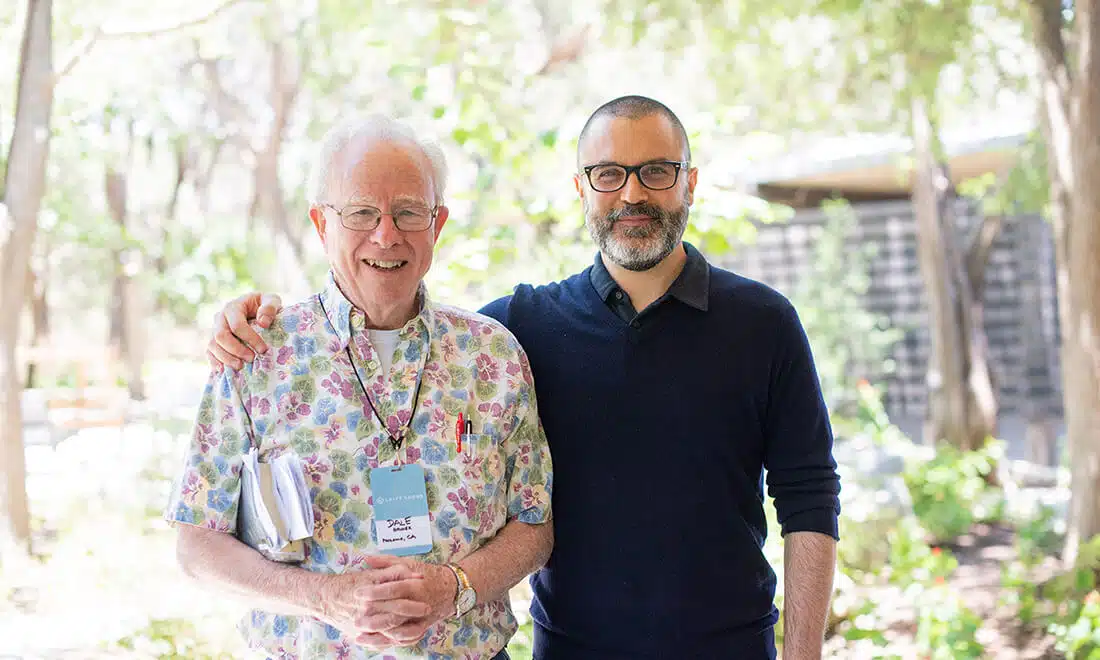
Dale Bruner and Adam Neder embody the mission of Laity Lodge by making complex things simple
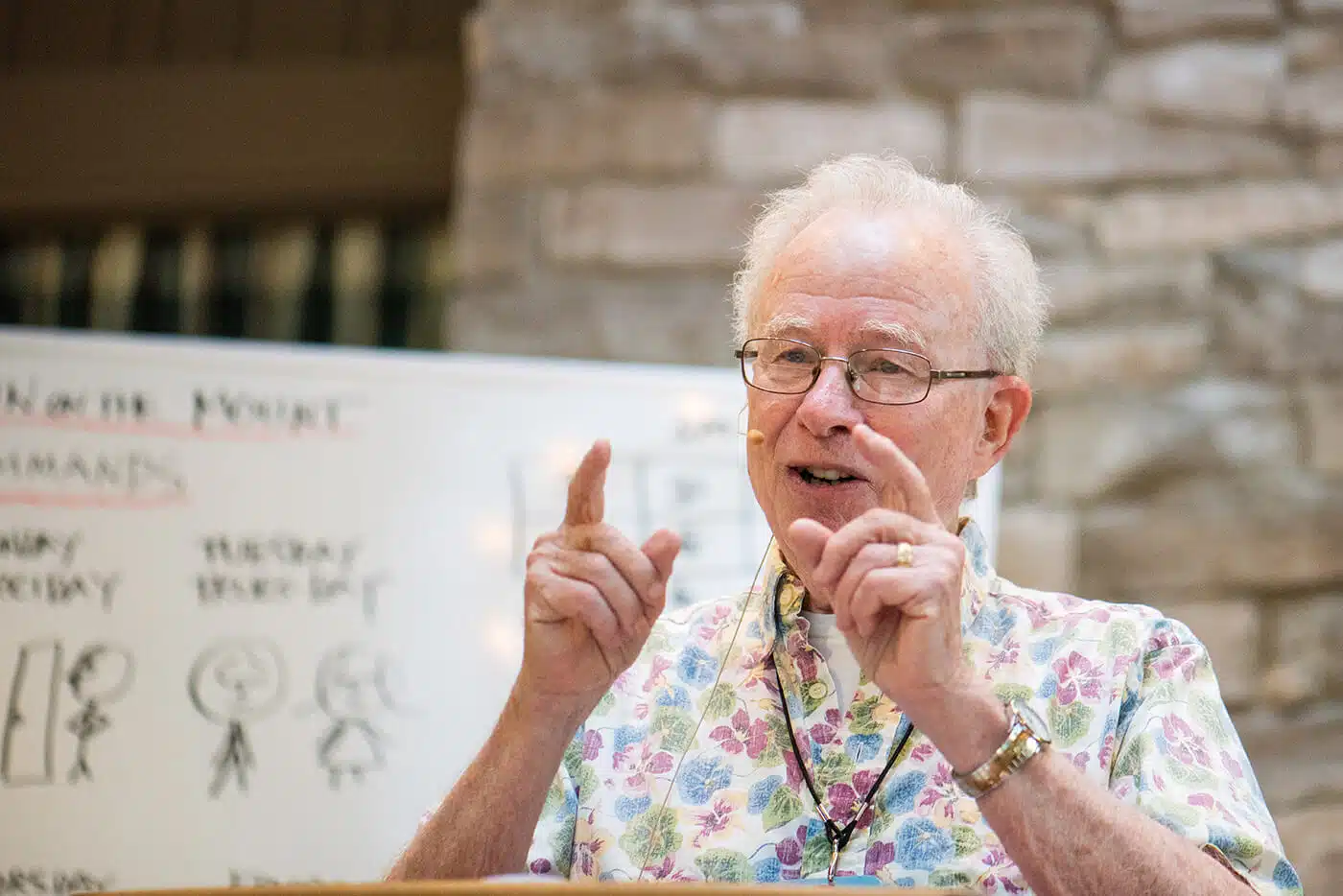
It’s an overcast Friday on the first morning of what will likely be the last-ever Laity Lodge retreat to feature theologian Dr. Dale Bruner as a guest speaker. Bruner stands at the front of the Great Hall and fills a large white board with a series of playful stick figures meant to elucidate elements of Jesus’ teaching in the Sermon on the Mount and what Jesus was trying to tell us about power, peacemaking, and more.
Bruner walks back and forth in front of a Great Hall brimming with Lodge guests, reading from the Scriptures, gesturing toward the white board, cracking wise here and there, and calling out some version of “Is this making sense?” over and over again.
This is Dale Bruner in his element—teaching the Bible by breaking it down into available, relevant, understandable parts. He’s been doing it for most of his 87 years—as a missionary in the Philippines, a professor of theology at Whitworth University in Spokane, Washington, and—perhaps most importantly to him—as a weekly Sunday School teacher at his local Presbyterian church, whether in Spokane or, since his 1997 retirement, in Los Angeles.
He’s also been doing it at Laity Lodge since the 1980s. Bruner can’t recall how many times he’s come to teach. His guess—“20?”—is conservative. And if this really is his last time, it’s only because travel is tough, time is more precious, and he needs to stay close to home for next week’s Sunday School.
Fortunately, Bruner’s legacy has legs. This weekend, Bruner has a co-speaker in one Dr. Adam Neder, who is helping him (and all the Lodge guests) tackle the eponymous question of the retreat: “Who Is Jesus?”
It’s a fitting pairing: Neder also teaches at Whitworth, where he holds the Bruner-Welch Chair in Theology. That chair was established in 2006 by Bill Welch, a businessman from Tulsa who was inspired by Bruner’s particular approach to Christian teaching—namely, one that offers academically rigorous scholarship that is accessible, engaging, and helpful to the church and the wider world, as Neder describes it.
“[Bruner’s scholarship] was every bit as serious and excellent as any academic,” says Neder. “Friends who are pastors have told me that Dale’s commentary on Matthew is the single best commentary on any book of the Bible they’ve read to help pastors prepare sermons. And it’s also really respected in the academic community.”
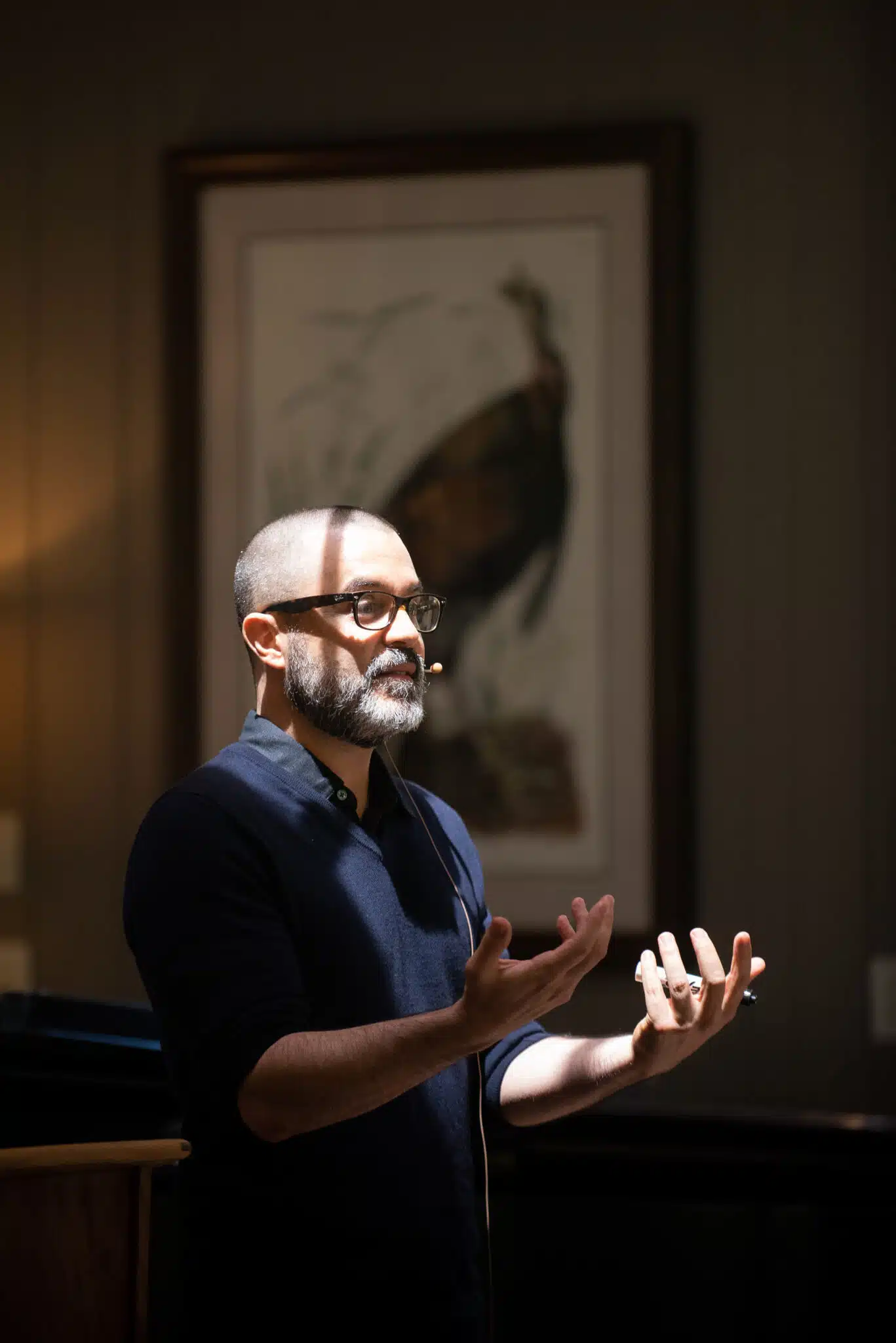
The chair was established to allow a scholar to carry on Bruner’s legacy in a practical way. Every fall and January session, Neder teaches a regular course load. But from February until the following fall, he’s meant to be “doing work that would benefit the church and the world and the academy”—writing and speaking, crafting his research and reflections into lessons that can reach a wider audience.
Forty-odd years separate the men, and their pedagogical styles are not the same. Where Bruner prowls the platform, Neder steadies himself behind the lectern. Where Bruner draws cartoons, Neder passes out lists of questions for interactive discussion.
Watching Neder teach in the wake of Bruner in the Great Hall, you can see why Neder sits in Bruner’s chair. But the same spirit hovers over both teachers: the spirit of teaching, breaking things down, helping us understand.
On this morning, Neder describes teaching the history of theology to the young students at Whitworth today, and watching their eyes glaze over. “I had to get them to think about Jesus” in all the surprising ways that the church fathers thought about Jesus, to address all the questions early church theology addresses about the nature of Jesus.
So he came up with a list of questions for them to answer. Questions like:
If LeBron James stepped into a time machine, traveled back to the year 30 AD, and played Jesus in a game of one-on-one basketball, who do you think would have won? And why?
Or:
What does Jesus look like? (Not what did he look like, but what does he look like?)
Or:
Is Jesus still a human being? If so, where is he?
These questions may seem silly. But if you think about them seriously and begin to talk about them with others, you realize what Neder has done—inspired you to get behind all your assumptions about Jesus and consider the building blocks of your theology. Before you know it, you’re doing the same thought work that the early church fathers did. On that retreat weekend, for a few minutes, the Great Hall was something like a scene from the Council of Nicea.
“Who is Jesus?” is a simple question. It’s also an endlessly complex question, one that will never finish being answered (well, almost never). Taking it, considering it, opening it up and seeing all it has to offer—this is the work of good teachers who care about talking to the people.
“The temptation to elitism,” says Neder, “has always been with us: We belong, and you don’t, and we help you see that by using language you don’t understand.” Bruner and Neder are models of resisting that temptation, and of how to turn spiritual things into a conversation that is for all of us—the laity.
If LeBron James stepped into a time machine, traveled back to the year 30 AD, and played Jesus in a game of one-on-one basketball, who do you think would have won? And why?


The Latest

Pairing service with travel, Students of Service—an organization we came to know through the H. E. Butt Foundation’s Capacity Building Program—invites teens to reimagine their communities and their roles within them.


President David Rogers reflects on the importance of listening as a leader.