
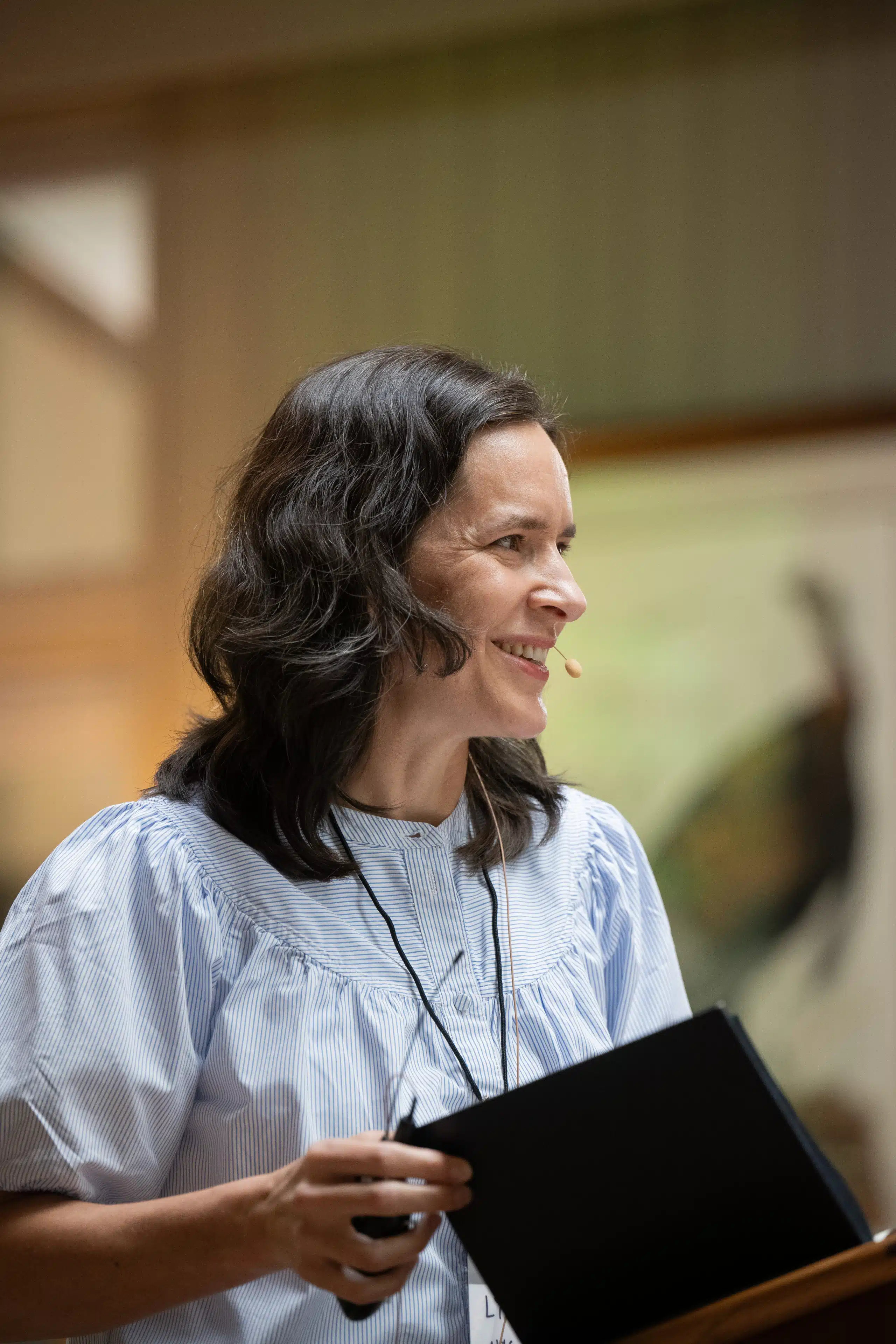


In this episode, New York Times bestselling children’s author Sally Lloyd-Jones discusses storytelling, faith, and rediscovering childlike wonder. Drawing from her books, including The Jesus Storybook Bible and Jesus, Our True Friend, Sally helps us explore themes of friendship, trust in God’s presence, and the freedom that comes from approaching faith like a child, allowing space for awe, imagination, and grace.
Watch The Podcast
NOTES:
00;00;08;18 – 00;00;28;29
Sally Lloyd-Jones
The first question I ask is how many people here think you have to be good for God to love you? And some hands go up, including mine. I sometimes think that. But then the second question I ask is on how many people here think if you stop being good, God will stop loving you.
00;00;29;02 – 00;01;01;15
Camille Hall-Ortega
Recently, my husband was reading the story of Noah’s Ark to my young son. As my husband described Noah marching all of the animals on to the ark. Two by two. My son asked, but what about the fish? That question delighted us. It was such a beautiful picture of childlike wonder. We often think of wonder as a strong sense of, or amazement, but it also often includes a spark of curiosity that might inspire deeper thought.
00;01;01;17 – 00;01;34;00
Camille Hall-Ortega
We think a lot about what we as adults teach children, but children teach us a lot, too, about childlike wonder stirring the simplest of questions, the most innocent of thoughts. It all points to attributes God wants to see in us humility, trust, and an unreserved capacity for all, all things we can always use more of. So what does it look like to tap into that childlike wonder, and how does it help stir up the very best picture of us?
00;01;34;03 – 00;02;00;07
Camille-Hall-Ortega
I’m Camille Hall-Ortega, and this is the Echo’s podcast. On today’s episode, we’re welcoming admired children’s book author Sally Lloyd Jones. Sally is a New York Times best selling author. She’s written over 40 books, including themed The Jesus Storybook Bible, which has been translated into 70 languages and sold over 6 million copies. We’re thrilled to chat with Sally today.
00;02;00;12 – 00;02;03;19
Camille Hall-Ortega
I’m here with my co-host, Marcus Goodyear. Hi, Marcus.
00;02;03;21 – 00;02;05;02
Marcus Goodyear
Hi, Camille.
00;02;05;05 – 00;02;06;23
Camille Hall-Ortega
Hi, Sally. Welcome.
00;02;06;23 – 00;02;09;03
Sally Lloyd-Jones
And thank you for having me.
00;02;09;05 – 00;02;32;11
Camille Hall-Ortega
Yes, we’re so glad to have you. We are admirers of your work. I have many of your books and read them to my kids. And they love them. And, they’re not alone. Because you have sold a lot of books and it’s used all over the world. Your books are. And so we’re so grateful just to chat with you today about your work and about you and your faith.
00;02;32;12 – 00;02;34;26
Camille Hall-Ortega
So thanks. Thanks so much for being here.
00;02;34;28 – 00;02;47;00
Sally Lloyd-Jones
Well, and I’m a huge fan of what you guys do and how you welcome artists, which is so amazing to me because that isn’t always the case. And I just I just love the whole ethos of everything.
00;02;47;00 – 00;02;58;08
Camille Hall-Ortega
So I’m so excited to hear more about your background and just how you’ve arrived, where you are. What has inspired you to do what you do to write books for children?
00;02;58;15 – 00;03;23;03
Sally Lloyd-Jones
Well, I think there’s something someone said is what you love to do before. So, so around 6 or 7, before you become aware of what someone else wants you to be. If you look back in your life and you look, what were you loving to do when you were about 5 or 6? We’ll often clue you in to what is really true to yourself and whether you do it for a living or not, it’s something you should do.
00;03;23;04 – 00;03;48;29
Sally Lloyd-Jones
Well, what I loved doing 5 or 6 was writing stories and drawing cartoons, and it was a long and winding road to ending up writing for children. I always loved writing, but I struggled to believe I was good enough. I thought you had to sound like fill in the blank. Sure. And, it took me a long time to realize, oh, wait a minute, actually, if I write well, and that is a brilliant editor said to me, you must.
00;03;48;29 – 00;04;02;02
Sally Lloyd-Jones
You need to write what makes you laugh. And I thought, well, I know what makes me laugh. So to actually start to realize the thing that makes you unique is to really be true to who you are. Not trying to sound like someone else.
00;04;02;09 – 00;04;03;18
Camille Hall-Ortega
You know, it’s so good.
00;04;03;21 – 00;04;07;20
Marcus Goodyear
Humor was the key for you to discover your voice. Is that what you’re saying?
00;04;07;22 – 00;04;26;20
Sally Lloyd-Jones
Right. It probably is, because the first book I ever remember reading, going back to. You know what? What did you love when you’re about to. Yeah. Was that Edward Lear’s The Complete Nonsense, which, if you know, that book is filled with drawings and in and limericks and I thought as a 7 or 8 year old. Oh, books are to teach me.
00;04;26;20 – 00;04;54;17
Sally Lloyd-Jones
And I didn’t learn the way people taught me, so I thought I wasn’t clever. So this was the first book I came across and read all the way through that didn’t that I thought I didn’t know you were allowed to have so much fun inside a book. And actually, all these years later, that’s my job to have fun inside a book so that I, and I really do believe my calling is to bring joy to children, whether it’s telling a Bible story or it’s telling a story about goldfish in New York.
00;04;54;22 – 00;04;55;02
Camille Hall-Ortega
Yeah.
00;04;55;03 – 00;05;17;29
Sally Lloyd-Jones
Or a or a a baby wren in the canyon. It’s all about bringing joy. So yes, it’s interesting to think and put that together, that the first book that really got me excited was a book full of limericks and funny drawings. And I thought, well, I could do that. And then I inflicted limericks on everyone, and that that was a good weapon because it was fun.
00;05;18;02 – 00;05;19;23
Camille Hall-Ortega
Yes, yes, yes.
00;05;19;25 – 00;05;23;16
Sally Lloyd-Jones
So, Edward Lear, as a complete nonsense. I recommend it highly.
00;05;23;18 – 00;05;45;19
Camille Hall-Ortega
Yeah. We’ll put it in the show notes. I’ve. I’ve not heard of it, but I’m now I’m excited to read it. That’s great. Well, I know that you get to have a lot of fun. You get to write children’s books, but you also get to read them to children and get to visit schools. And I’m really curious what kind of things you hear from kids that we mentioned that we can learn a lot from kids.
00;05;45;24 – 00;05;52;21
Camille Hall-Ortega
I’m curious about some fun stories that you have of things kids have said to you, but also kind of learnings that you’ve gathered along the way.
00;05;52;24 – 00;06;21;06
Sally Lloyd-Jones
Well, I suppose I sort of the poignant thing is I’ll go into schools and libraries and churches and I will ask them, the children, the two questions. The first question I ask is how many people here think you have to be good God to love you? And some hands go up including mine. I sometimes think that. But then the second question I ask is and how many people here think if you stop being good God will stop loving you.
00;06;21;08 – 00;06;42;17
Sally Lloyd-Jones
And then almost every hand goes up. And I think even as adults we struggle with that. We might believe, oh yes, God can forgive me when I become a Christian, but we struggle to think that somehow we get this expectation that as a Christian then we should never be sinning. Obviously, we don’t want to be sinning, but we somehow get this idea that we’re not still broken.
00;06;42;17 – 00;07;06;28
Sally Lloyd-Jones
And anyway, these are children who know the Bible stories, and that is what the Bible is all about. And so I learn from them in that sense, but I also learn from them in the wonder and I was reading my new book, Jesus, Our True Friend, took a class and I was reading about Mary and Martha and I, and at one point in the story and they’re all it’s in a Christian school.
00;07;06;28 – 00;07;26;05
Sally Lloyd-Jones
So all being very well behaved all in a row and really listening. And it was wonderful. And I get to the point where Martha, I say something like, Martha had just go to Jesus and told him what to do and told him he didn’t care. And this little boy went, oh, and gee, it was a.
00;07;26;07 – 00;07;27;14
Camille Hall-Ortega
Distraction.
00;07;27;16 – 00;07;29;01
Marcus Goodyear
Yes.
00;07;29;03 – 00;07;52;16
Sally Lloyd-Jones
So the thing about children is they’re so that it’s that wonder we were talking about is just that full of wonder. And, and the other thing I’ve learned, I learned this from a teacher. I, you know, I mean, it’s very easy to read a story in the context, like your. Well, I’ll tell you the story. I was entered at a Sunday school, and I was reading the story of Daniel from the Jesus Storybook Bible.
00;07;52;16 – 00;08;10;03
Sally Lloyd-Jones
And the teacher left, and I’m very good at getting children excited. I’m not very good at getting them to, you know, calm down. So I read the story and as I was reading the story, It was this little girl who was so eager, she was almost trying to get into my lap. And because she was so into the story.
00;08;10;05 – 00;08;29;17
Sally Lloyd-Jones
Yeah. And she just was full of wonder at the end of the story. The teacher wasn’t there and I panicked. And out of my mouth, I heard myself say to my horror, so, children, what can we learn about what? How from Daniel about how God wants us to behave? The very question I should never be asking, but I will never forget.
00;08;29;17 – 00;08;52;03
Sally Lloyd-Jones
Because physically, That little girl who’d been so full of wonder, her head bowed and actually physically slumped in front of me, and it was a picture of what happens to a child when we turn a story into a sermon and a lesson, because I made it all about her. And it isn’t all about her. It’s not. And so that’s telling a story on myself.
00;08;52;06 – 00;09;12;09
Sally Lloyd-Jones
And I learned the best way from a teacher where she was telling them the story of the feeding of the 5000. She was sitting with the children cross-legged, so she was on the same level physically. And at the end of the story, instead of saying, well, children, now what can we learn from this? Feeding the 5000 about how God wants us to share our lunch?
00;09;12;12 – 00;09;26;03
Sally Lloyd-Jones
She didn’t say that. She said wow. She wondered out loud and she said, I wonder what would happen if I gave Jesus everything I have and suddenly it opened up everyone to wonder.
00;09;26;05 – 00;09;36;23
Camille Hall-Ortega
I love that idea of really sparking curiosity that the story that God uses his story in the way he wants it to be used, and it might be different for each person.
00;09;36;25 – 00;09;54;09
Sally Lloyd-Jones
Yes, and I think of a story like a seed. And the thing about a seed is you don’t really want to be digging it up and looking at it, because you’ll kill it. What if you just trusted children to hear from the Heavenly Father and you trusted the Heavenly Father? You’ll have that Heavenly Father to speak to their children.
00;09;54;11 – 00;10;05;29
Sally Lloyd-Jones
And you just provided the seed, and then you let God do the rest. And it might not show itself until they’re 25 or 30, but it will be in their. I think that’s exciting.
00;10;06;06 – 00;10;09;26
Camille Hall-Ortega
It’s planted. Yeah. Good. That’s really good stuff.
00;10;09;29 – 00;10;31;25
Marcus Goodyear
Hearing you talk about the way children respond to stories and the way you as an adult, kind of fall into this adult habit of responding to stories makes me wonder, there’s that word again. How would you describe the difference between a child’s approach to a story, which maybe is the natural human approach and the adult approach to story?
00;10;31;25 – 00;10;34;16
Marcus Goodyear
And like, how do we fall into that trap?
00;10;34;19 – 00;10;55;03
Sally Lloyd-Jones
I sort of think we don’t trust adults, we don’t trust stories we like. And I think is because we can’t control stories. We like control. We like bullet points, we like summaries. And I see this a lot. When I look at a book, it’ll often be it’ll be illustrated and everything, but it’s a summary and it’s all bullet points and it’s teaching.
00;10;55;06 – 00;11;15;20
Sally Lloyd-Jones
And there’s nothing wrong with teaching. But a story is the power of the story is the story. So I think as we can easily get into this idea of trying to control how the child receives the story, but we don’t do that to ourselves when we’re like, if we’re watching an amazing film or we’re reading an amazing book, how often do we then do that to ourselves?
00;11;15;20 – 00;11;29;13
Sally Lloyd-Jones
We don’t, but we do it to children. And I think it’s because we mean well, because children need guidance and they need know leading and they need rules, but they certainly don’t need this in a story that’s really.
00;11;29;15 – 00;11;47;15
Camille Hall-Ortega
Really illuminating for me because I’m thinking I’m guilty as charged of trying to control and and for something that’s meant to be so creative and meant to be a spark, how freeing it is to just go let them sit with it.
00;11;47;17 – 00;12;08;28
Sally Lloyd-Jones
Yes, I think I think, you know, because parents and all of you know, anyone who has little ones in their life, we mean, well, we’re just trying to help. But yeah. And when it comes to the devotional life of children reading the Bible, I think we have to tread carefully and let it not become another sort of like they’re at school, they go to school, they have all these lessons.
00;12;09;04 – 00;12;33;01
Sally Lloyd-Jones
This might be the area to just not teach, not try and teach them, but let the story capture their imagination. And I also think, you know, in all the things we’ve given children, we sometimes I wonder, have we forgotten to give them hope? Because if we keep turning it into a lesson, it’s all despairing because the moral code is always going to leave us in despair because we’re never good enough, you know?
00;12;33;04 – 00;13;02;18
Camille Hall-Ortega
So good. What’s so good? I, I know that you write children’s books, but I have seen over and over people reviewing your books or commenting about your books, and it’s adults saying, I know this is for kids, but I love it. I know this is for kids, but here’s how I use it. I know this is for kids, but I read the version of this story from your book, The Jesus Storybook Bible to my Bible study, because I love how it did this or did that.
00;13;02;20 – 00;13;09;00
Camille Hall-Ortega
How often are you seeing how much adults love your books too? And why do you think they’re so drawn to them?
00;13;09;03 – 00;13;37;11
Sally Lloyd-Jones
Yes, I had no idea that was going to happen when I was writing the book, and if I had, it would have probably freaked me out to think theologians in the past. But I love the fact there’s something lovely about the fact that God would use a children’s book to reach grown ups, and I think it’s because he’s reaching the child in us, and it’s the undefended heart of our hearts that because it’s a children’s book, no one has their defenses up.
00;13;37;13 – 00;13;57;16
Sally Lloyd-Jones
They’re a bit more open because it’s just it is. An invite should come as just a children’s book. So how threatening is it? It’s not threatening. And so I think you come to it a bit more open and also the lyrical language is how God speaks to us in the Bible as his children. So it it sort of fits.
00;13;57;16 – 00;14;19;06
Sally Lloyd-Jones
And I think we kind of get complicated and the simplicity of it. And I think if you, you don’t dumb down, you know, you make it simple, but you don’t make it simplistic, then it will contain the depth of the theology without reducing it into, you know, something that won’t reach anyone.
00;14;19;08 – 00;14;43;08
Camille Hall-Ortega
I, I want to hear more about that, because when I think of some of the ways that you have interpreted the Bible stories, that’s exactly how I think of is that you have made it so simple but really beautiful, and you’re accomplishing so many goals at once in that you’ve interpreted it in a way that’s appropriate for children where they can understand what’s happening.
00;14;43;10 – 00;15;12;13
Camille Hall-Ortega
There’s also entertaining and humorous and, but some of the things that are the stories that are being told are really tough, really complex, or really, can be, you know, something scary involved. What do you do, process wise or heart wise or what have you, that allows you to sort of tap into what leads to your interpretation?
00;15;12;15 – 00;15;31;21
Sally Lloyd-Jones
Yeah. Well, it’s, I have to do a lot of research before I write to make sure I’m getting the theology straight, and it’s really that thing I, I don’t remember who said it, but if you can’t, if you can’t explain it to your grandmother, you don’t understand it. At least you know. And I think I heard Tim Keller say this.
00;15;31;21 – 00;15;55;02
Sally Lloyd-Jones
Or someone, he might have been quoting someone else, but that you have to go. You have to go through a complexity to the other side to get to simplicity. But if you stop short of complexity, it will be simplistic. So you have to really understand the theology and wrestle with it yourself and work out all the bumps so that you can then distill it down to the essentials.
00;15;55;04 – 00;16;14;09
Sally Lloyd-Jones
So for me, with a children’s story, you know, when I’m writing for children, and in my new book, Jesus Our True Friend, I had seven stories and I had to decide for each. I mean, I basically just started working on different stories that I hadn’t retold before. And I they started to come together into a theme of friendship.
00;16;14;13 – 00;16;24;05
Sally Lloyd-Jones
But for each story, I had to sort of choose one, one facet, maybe so that the whole book was creating a picture of Jesus.
00;16;24;05 – 00;16;45;27
Marcus Goodyear
I just I love this book. The I love the way you tell Mary and Martha and the moment where you say people back then thought girls weren’t as important as boys. It’s just so funny and, like, causes you to examine. What are we doing today? Are we are we really that much different? I love your phrase, the extra super holy people that you shot several times.
00;16;46;00 – 00;17;15;02
Marcus Goodyear
Yeah, that. Yeah, that really hits home. But the one that hits home the most for me is when you’re telling the story of the Good Samaritan and you say the lawyer wanted to know who were his, not neighbors, so that he didn’t have to love them. And they just kind of broke my heart. How do you reach these these phrases that unlock something that we’ve read so many times before?
00;17;15;04 – 00;17;37;13
Sally Lloyd-Jones
But I suppose it’s it’s telling on your own self, isn’t it? Really? And it’s the playful thing. It goes back to that any time I can be playful or funny. The thing about humor is you make someone laugh, but it also opens them up. That’s probably why it works, because it’s funny, but it’s also, you know, when people are laughing their own.
00;17;37;14 – 00;17;39;20
Camille Hall-Ortega
True. Got.
00;17;39;22 – 00;17;59;07
Sally Lloyd-Jones
Kind of gets you, doesn’t it? Yeah. And yeah. And it’s interesting because that’s kind of where we are in our culture at the moment, isn’t it? Whose are not neighbor. So we don’t have to love them. And, you know, it’s so interesting. Tim said this. Tim Keller said the danger of criticism isn’t to my reputation. It’s to my heart.
00;17;59;09 – 00;18;20;07
Sally Lloyd-Jones
And that’s probably feeding. Feeding into this is we. The minute we start saying, well, those people hurt me and they did this, and you want to make them the bad. You end up doing exactly what they’ve just done to you. So there’s no I think that was playing on my mind is there’s no escaping. If we start, you could be wronged.
00;18;20;07 – 00;18;27;27
Sally Lloyd-Jones
But the minute you turn around and, you know, demonize and otherwise you’ve you’ll know better.
00;18;27;29 – 00;18;34;09
Camille Hall-Ortega
I’m wondering also, about how your work inspires you and your faith.
00;18;34;11 – 00;19;03;06
Sally Lloyd-Jones
Well, what the lovely thing about it is it I, I’m always on the lookout for. Ideas and beauty and even I mean this is a good thing about Instagram is it makes me look for beauty. I’m on the lookout like it’s, you know I think that’s a really good practice. That’s come. And Henry, I think Henry James said, you have to be the one on whom nothing is lost as a writer.
00;19;03;08 – 00;19;04;25
Camille Hall-Ortega
00;19;04;28 – 00;19;25;01
Sally Lloyd-Jones
But that could well be a description of us as Christ followers. We need to be people on whom nothing is lost. Because don’t you find like that? If you’re in the right frame of mind, you receive all kinds of blessings as God’s personal gift to you. I was talking with a friend yesterday. If you’re in that receptive place, you see so many evidences of God’s kindness.
00;19;25;07 – 00;19;45;19
Sally Lloyd-Jones
Yeah, but if you’re not in that place, you’re shut off and you missed. What are you missing of what God’s sending, you know. You know, and we’ve all done this way. You could be on a walk and you’re just thinking in your head and all these thoughts, and you don’t even really notice anything about you. It’s like when you spend time with the dog that helps you because they’re so over there in the moment.
00;19;45;22 – 00;20;01;12
Sally Lloyd-Jones
They’re so thrilled with everything they teach you that they. Yeah. So I think my work has has given me it’s a discipline of really noticing and expecting. That thing is expecting amazing things to happen.
00;20;01;14 – 00;20;26;19
Camille Hall-Ortega
Well, it’s it’s harkening back for me to this, this idea of capacity for all and sort of tapping into this childlike wonder, because who do we see kind of, really wide eyed and, and taking everything in. But kids, kids who are experiencing something new, they remind us of, oh, that is beautiful. Or yes, you’re right, those are really green.
00;20;26;19 – 00;20;41;00
Camille Hall-Ortega
I hadn’t been thinking about that because it’s not lost on them. Right. And it’s yeah, it’s lost on us because we’re jaded or because we’re distracted or because we have a lot of noise that surrounds us.
00;20;41;02 – 00;21;07;03
Sally Lloyd-Jones
Or I guess, yeah, that’s it. And it’s that thing, hedonic adaptation. We get used to nice things. I know I learned that from the Yale happiness class, which was so good I did that in the, pandemic. It’s really good. Anyway, one of the things she said is the way to break yourself out of that is to go, what if, you know, like I have a friend who’s blind?
00;21;07;05 – 00;21;09;08
Sally Lloyd-Jones
I take it for granted that I can see.
00;21;09;10 – 00;21;37;10
Marcus Goodyear
Yeah. I want to think a little bit about this idea of how we regain the sense of wonder, how we regain the sense of, And that reminds me of this audio clip from Laity Lodge from 1976 that Camille found actually earlier this week by Father Keith Hosey. He was a Catholic priest in Texas at the time, and he was at Lady Lodge talking about becoming a child.
00;21;37;13 – 00;21;41;29
Marcus Goodyear
And so I’d like to just play this clip and get your response to it. Sally.
00;21;42;01 – 00;21;59;04
Keith Hosey
When we’re left child, people ask us, what are we going to be when we grow up? The butcher, the baker, the candlestick maker. Life is just all kind of people making up all kind of things for us. Do. And they keep saying, what you gonna be when you grow up? And that’s what you’re going to be, and you don’t know and you act like you know, and you go through all that turmoil of trying to be what other people want you to be.
00;21;59;10 – 00;22;19;11
Keith Hosey
And then somewhere along the line, you finally say, well, here I am. I’ve gone to school, got a job and a wife, loving children, family. What am I trying to be now? And then the voice comes through very clearly. It’s in the New Testament. Unless you become as a child, you’re not even entering the kingdom. Wow, that’s pretty heavy.
00;22;19;13 – 00;22;38;26
Keith Hosey
And in words. What a grown ups do. What are they going to be when they grow up? We’re going to be kids. And who is going to create the child? The only parent the child now has once you’re grown up is yourself. You are responsible for the child within you, and you are the one who will help it grow up and learn to play again.
00;22;38;29 – 00;22;40;17
Marcus Goodyear
What do you think, Sally?
00;22;40;20 – 00;23;08;18
Sally Lloyd-Jones
That’s wonderful. But it’s completely true, isn’t it? And I think the thing is, I love that because we’re so obsessed with what will we be? What will we do? What job will we do? A child is not obsessed with that. The child is just in the moment, a bit like we were talking earlier in the moment. And the thing about a child playing is because they know that parent is there, that they’re free to play, aren’t they?
00;23;08;18 – 00;23;39;07
Sally Lloyd-Jones
Like a toddler is really happy playing if the parents there, but if the parent isn’t there, then the child is anxious. So as grown ups, we go on as if we don’t have a Heavenly Father because we’re anxious and we’re not playful, and we’re trying so hard and we’re trying. But if we knew that our Heavenly Father is there with us, and we really were working that muscle of trust to say, I give you everything, I trust you completely, and you know better than me how it all should go.
00;23;39;10 – 00;23;58;25
Sally Lloyd-Jones
And we would be so much more playful and we, we would still be doing what he’s called us to do. But we would first of all, be with him. I think that’s the key. It’s like his presence. And I’ve been thinking about that lately. Just if I really believed what I believe, it would change everything.
00;23;58;28 – 00;24;24;14
Camille Hall-Ortega
That’s so good, Sally. I love this idea of this security that we have with our kids. Security that they have is what allows them to feel free. That it’s the guardrails. It’s that that kids play better when they’re in a fenced in playground, that they wouldn’t feel as comfortable at a playground that didn’t have boundaries. And, it’s the security that comes with that, that feeling of being secure.
00;24;24;17 – 00;24;34;25
Camille Hall-Ortega
And I love that you’re reminding us that that’s exactly what we can have with God. We have a freedom in him as our security that’s beautiful.
00;24;34;28 – 00;24;49;09
Sally Lloyd-Jones
And that we don’t have to. No child, little child is thinking about tomorrow and how they’re going to get this or that. And what are they going to do? They know that parent is in charge. Yeah. Wow. That would be amazing if we could be more like that.
00;24;49;11 – 00;24;52;19
Marcus Goodyear
Now, can I throw a wrench in this thing?
00;24;52;19 – 00;24;52;28
Camille Hall-Ortega
Yeah.
00;24;52;28 – 00;25;18;02
Marcus Goodyear
So I’m thinking about your new book, Jesus, Our True Friend. And the great storm of God’s Anger that you talk about. And so we’re talking about trusting God as our father. And yet, in the great storm of God’s anger, you have not just you. I mean, this is the common Christian story of Jesus saving us from God, and God’s anger.
00;25;18;04 – 00;25;31;09
Marcus Goodyear
And I’m just curious, how do you hold those things together? How do you both acknowledge the the anger and the storm and the fear and look to God for security?
00;25;31;12 – 00;25;55;17
Sally Lloyd-Jones
Well, we’re being saved from the storm of God’s great anger at sin. We’re not being saved from God, God and Jesus. They’re both coming to rescue us in the storm. So there’s no separation. Everything we see in Jesus’s father, there’s no difference now, both loving us like that the way I see it is, it allows us to see the world as it is and in all its brokenness.
00;25;55;19 – 00;26;18;26
Sally Lloyd-Jones
And if we’re angry at it, God’s anger is much worse because he he loves us and he loves the world, and his his anger is not is against sin and brokenness and dying and tears and sickness. And he’s out to destroy those. He’s not out to destroy us, but the only way he can destroy those without destroying us is by his sacrifice.
00;26;18;28 – 00;26;37;06
Sally Lloyd-Jones
And that sacrifice is the father and the son and the Holy Spirit together coming to rescue us. Not, you know, often we get this idea that Jesus is the nice one and God the Father’s angry one. Yeah, I used to think that was a little girl. It’s so wrong. And I sometimes think how how much pain that was caused.
00;26;37;06 – 00;27;01;21
Sally Lloyd-Jones
God the father, because they made this plan, the father, the son, and the Holy Spirit made this plan before the foundation of the world. And the wrench of a parent letting their child, you know, it’s just it breaks your heart to think, you know, but that that kind of love that would go into the center of the storm of God’s great anger at sin and take it so we can survive.
00;27;01;23 – 00;27;02;24
Sally Lloyd-Jones
That’s beautiful.
00;27;02;26 – 00;27;03;17
Camille Hall-Ortega
00;27;03;22 – 00;27;26;08
Sally Lloyd-Jones
Because it doesn’t doesn’t minimize the reality of the world we’re in and the brokenness and yes, in this world we will have trouble. But be of good cheer Jesus tells us I’ve overcome the world. That’s it’s hope because it doesn’t deny what we have to get. I mean, we don’t like that this is a broken world. We don’t like that we we we suffer.
00;27;26;10 – 00;27;40;01
Sally Lloyd-Jones
But what are the way through? Are we given? We’re given this amazing hope that this isn’t the end and he’s overcome it and he’s with us. That’s the main thing. He’s with us. Yeah. He won’t ever leave us.
00;27;40;03 – 00;27;41;23
Camille Hall-Ortega
He’s our true friend.
00;27;41;25 – 00;27;42;22
Marcus Goodyear
Yeah.
00;27;42;24 – 00;27;43;17
Sally Lloyd-Jones
Yeah.
00;27;43;19 – 00;28;01;06
Marcus Goodyear
Well, I mean, you just use the word friend, right? Camille and, Sally, you say when you were a kid, you used to think these ways. Well, for me, it was like last week, right? It’s. These are these are problems in my in my faith, in my belief that I just carry with me all the time. And I know that, it’s challenging.
00;28;01;06 – 00;28;32;22
Marcus Goodyear
Right. And so when I read about Jesus as a friend, I, I love that idea. I love that as a metaphor. And yet I know it must mean something a little bit different than me and my my good friend Mitch or my good friend Jeff hanging out on their porches. And so I’m curious if you can talk about the idea of Jesus as a friend in terms of who your deep friends are in the world, and how your relationship with Jesus is similar or different from that.
00;28;32;25 – 00;28;56;26
Sally Lloyd-Jones
Well, I suppose I think friendship is undervalued in our society. Oh yeah. So yeah. So I wrote about that with the four loves. And the thing is that the beauty of that no greater love has any man than this, that he laid down his life for his friends. Yeah. That’s what I think of because a friendship, because he chose us.
00;28;56;26 – 00;29;04;24
Sally Lloyd-Jones
He doesn’t have to do this. He chose to do this. Yep. And a friend is someone you can be completely open with.
00;29;04;26 – 00;29;23;29
Camille Hall-Ortega
That’s exactly what I’m thinking, Sally. I think the same way. I think Marcus and I were discussing your book and I was saying, ash, it’s so beautiful. He’s like, yes, it’s beautiful. And when he was asking some of those questions like, I’m so intrigued by the title. And so my first reaction is, well, it’s biblical. God told us that, yes, yes, it’s our friend, right?
00;29;23;29 – 00;29;30;13
Camille Hall-Ortega
Like it says it and it says I, it’s closer than a brother. He would lay down his life.
00;29;30;19 – 00;29;50;04
Sally Lloyd-Jones
And Noah, he was a friend of not Noah was his friend, you know. Yeah. In the Bible it’s a dignified, wonderful, precious gift. I mean, my children. Yeah. The love, I think the friend thing, especially for a child to know that God is his friend, that he could go to at any time. Yeah. I think that’s so beautiful.
00;29;50;06 – 00;30;13;01
Sally Lloyd-Jones
I think it’s mysterious, isn’t it? And again, it’s I’m only choosing one facet of who God is to us. But I don’t know that we’ve we celebrate friendship enough. And the way he and all the stories in that book, I’m just so moved by how he is with Martha and she’s so out of control. Yes, frantic. But he’s a real friend to her.
00;30;13;03 – 00;30;35;13
Sally Lloyd-Jones
And how he is with Peter when he restores him. He’s so gentle. And so, you know, I find it so moving that the place that Peter betrayed him by a charcoal fire, he leads him to a charcoal fire to restore him. That’s so. There’s such a tenderness in this friendship that I think friendship gets at a tenderness and a for you.
00;30;35;16 – 00;30;42;02
Sally Lloyd-Jones
And, a yeah, a companionship maybe. Yeah. Never alone.
00;30;42;05 – 00;30;57;00
Camille Hall-Ortega
Just thinking about how, you know, sometimes those concepts can feel really strange to us because you’re like, I’m not texting Jesus. Like, I text my bestie, right?
00;30;57;02 – 00;31;02;08
Sally Lloyd-Jones
But I love maybe we could be right. Maybe we. Types of prayers.
00;31;02;13 – 00;31;21;17
Camille Hall-Ortega
This exact text exactly where I’m going. That right that I try to think of something that I do with my best friend that I cannot do with Jesus. We. I can spend time with God. I can he he is a friend who will never miss a text. He will never miss a phone call. Right? He is always with me.
00;31;21;17 – 00;31;42;20
Camille Hall-Ortega
I don’t want to just schedule time with God. He’s with me always. And so I just have to be intentional about engaging him in that way. And so even though it’s kind of weird and can get kind of pious and strange sounding at its basic level, it really is kind of amazing that God paints these pictures for us.
00;31;42;20 – 00;32;02;15
Camille Hall-Ortega
And he says, well, maybe it’s weird that I’m saying that I’m like a father and you don’t have a great picture of fathers, but I’m the perfect father. And maybe it’s weird that I’m calling myself your friend. And, you’re not texting me. Or sometimes you have falling out with friends, but I’m the perfect friend. There’s a beauty in that.
00;32;02;16 – 00;32;04;12
Sally Lloyd-Jones
Yeah, yeah.
00;32;04;15 – 00;32;16;01
Marcus Goodyear
I think you guys are just better at this than me because I’m like, Jesus, why are you not texting me back? I mean, come on, I want to I want to return text that’s of my other friends do. But then I think another thing is, yeah.
00;32;16;04 – 00;32;17;19
Camille Hall-Ortega
Tell us.
00;32;17;21 – 00;32;20;23
Sally Lloyd-Jones
You know, it’s going to say no, you hadn’t finished. You finish, Marcus.
00;32;20;26 – 00;32;40;01
Marcus Goodyear
Well, then then I think about Thomas Keating and this little quote that I have on my desk, and he says, the chief thing that separates us from God is the thought that we’re separated from God, and that I take great comfort in that because I have this constant thought that I’m separated from God, and I just need to remind myself that that thought alone is the problem.
00;32;40;03 – 00;33;04;13
Sally Lloyd-Jones
Yeah. And and it’s okay. The other thing is it’s a sign of faith to have a struggle isn’t it. How can we not know. I mean it’s definitely didn’t beat say if there was no room for doubt there’d be no room for me Henry. You know, bleakness of that. Yeah. And but the thing I love about what Tim Keller said, the key is like the song.
00;33;04;13 – 00;33;33;03
Sally Lloyd-Jones
The psalms of the Psalms are filled with this. They’re filled with praise. They’re filled with questions and anger and raging and everything. And the key is to go and do this with God, not away from God. Yeah. So you wrestle with all of these questions, but you do it with God in front of him. Because what the danger is, is that we think, oh, we’ve got to go and wrestle these things, and we turn from God and try and do it in our own strength, which is never going to work.
00;33;33;05 – 00;33;53;07
Sally Lloyd-Jones
Yeah. If you do it, as the psalmist does, in front of God with God, and you rage and you have all your feelings, that’s where I think we honor him. And he’s not frightened of our confusion and all. Yeah, I don’t like this and I don’t like that or whatever it is. I think it really shows a lot of faith when we do that.
00;33;53;10 – 00;34;09;09
Camille Hall-Ortega
Yes, I agree, I think, what an amazing God that we serve, that our questions don’t scare him, that our doubts. Yes. Don’t push him away. That he says come closer, come closer. I want to I want to talk with you about that, which I think is gorgeous.
00;34;09;12 – 00;34;11;17
Marcus Goodyear
I do wish he would text me, though.
00;34;11;19 – 00;34;34;15
Sally Lloyd-Jones
I sometimes. I sometimes just do a simple prayer of come into this anger other come into this confusion. Just inviting him in to everything we’re feeling because and it can just that can be a tiny text prayer contact. Come and help me with this. Or just help. That’s all Peter said when he was sinking. Hell yeah. So I and Jesus did the rest.
00;34;34;18 – 00;34;35;12
Marcus Goodyear
That’s right.
00;34;35;14 – 00;34;57;02
Sally Lloyd-Jones
You know, so much of it is shame that we think we’re supposed to be better than we are. And I just find so much freedom and knowing I’m. I can’t do it. It’s grace. It’s all grace. So all I have to do is really just. Well, Dallas Willard said the most important thing for our soul is to keep God at the forefront of our mind.
00;34;57;04 – 00;34;58;17
Marcus Goodyear
Yes.
00;34;58;19 – 00;35;22;09
Sally Lloyd-Jones
That’s really it. Just keep turning back to him, turning and turning all through the day. And it’s sort of like they say in meditation that the key isn’t that you have this amazing, you’re never distracted time. The muscle is when you keep catching yourself and turning back. That’s the key. So I like that idea that to catch myself and go, oh God, help!
00;35;22;11 – 00;35;24;05
Sally Lloyd-Jones
Yeah, yeah. Throughout the day.
00;35;24;08 – 00;35;43;05
Marcus Goodyear
That reminds me of another Thomas Keating thing where this woman, who is trying to meditate and she went to him and said, you know, I meditated for 20 minutes and I just I kept just being distracted. And 10,000 times in my mind I had to turn back. And he said, isn’t that wonderful? 10,000 times you made a decision to turn back.
00;35;43;07 – 00;35;45;14
Sally Lloyd-Jones
See? That’s beautiful. I love that.
00;35;45;16 – 00;36;05;24
Camille Hall-Ortega
That’s good. Sally, you’ve given us so many good things to think about, and I’ve just loved getting just a little bit of, hearing about your process and your curiosity. I know you are doing a lot of fun things. We’ve talked a bunch about your new book, which we love. We’re. Yes. And it’s so beautiful. So thank you.
00;36;05;27 – 00;36;08;25
Camille Hall-Ortega
So where can folks get this book?
00;36;08;28 – 00;36;21;04
Sally Lloyd-Jones
You can get it. I have a website which is Sally Lloyd-Jones dot com. I so that it’s available there or in bookstores and I’m on Instagram and Facebook so I can connect with people.
00;36;21;06 – 00;36;25;10
Camille Hall-Ortega
Yes. I’m sorry. And so what on the horizon for you, what do you have coming up. We’d love to hear.
00;36;25;12 – 00;36;45;00
Sally Lloyd-Jones
Well, very exciting is that I’m going on tour with Jon Guerra, who I love, and I know he’s been on your podcast and yes, yes, where we’re doing a it’s sort of a it’s not really a book reading and it’s not really a concert. It’s an experience where it’s music and word. I tell stories about growing up in Africa, my journey to becoming a writer.
00;36;45;00 – 00;37;09;07
Sally Lloyd-Jones
I also read from the books and Jon sings and we sort of they overlap and around and it’s beautiful. And, so we’re doing that and we’re coming to San Antonio. And so that’s the beginning of May. And tickets are on sale now. So we’d love to see people and we’ll do some signings and greetings and it would be fun.
00;37;09;10 – 00;37;11;28
Marcus Goodyear
Excellent. We’ll put links to all of this in the, in the notes.
00;37;11;29 – 00;37;38;20
Sally Lloyd-Jones
Oh lovely. Yes. And it’s really a celebration of what I mean by telling my own story. It’s a, it’s a celebration of looking back and seeing what God what God has, how he speaks to children. Really, because I tell a story about in my childhood and how it’s come full circle and I think, and I’ve done this before, parents will come up and say, wow, I now think I need to listen to my eight year old because children hear from God.
00;37;38;20 – 00;37;54;10
Sally Lloyd-Jones
So it’s just a lovely it’s mostly if, elementary school, if you shouldn’t, it wouldn’t be little children because it’s more of a grown up thing. But anyway, it’s it’s a fun testimony of how great God is and what he’s done. And beautiful music.
00;37;54;13 – 00;38;01;27
Camille Hall-Ortega
Well, we I really hope that we get to go and, we’ll, we’ll include those links. But, Sally, thank you. This has been just a wonderful.
00;38;01;28 – 00;38;05;24
Sally Lloyd-Jones
It’s been lovely. Camille and Marcus, thank you so much. What a lovely conversation.
00;38;06;00 – 00;38;28;18
Camille Hall-Ortega
Yes, yes. Thank you. The Echoes Podcast is written and produced by Marcus Goodyear, Rob Stinnett and me, Camille Hall Ortega. It’s edited by Rob Stinnett and Kim Stone. Our executive producers are Patton Dodd and David Rogers. Our original music is by Johnny Rodgers. Special thanks to our guest today, Sally Lloyd-Jones. In addition to The Echoes Podcast, we welcome you to subscribe to Echoes magazine.
00;38;28;21 – 00;38;44;10
Camille Hall-Ortega
You’ll receive a beautiful print magazine each quarter, and it’s free. You can find a link in our show notes. The Echoes Podcast and Echoes magazine are both productions brought to you by the H. E. Butt Foundation. You can learn more about our vision and mission at H-e-b FDN .org.


